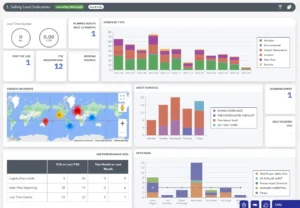


You can’t be in all your stores at once. EcoOnline can.

EcoOnline is the single view that turns 50 problems into manageable trends you can prioritise and address.

Retail Header Image
Tesco Black And White Logo No Border
Quote Icon

We like the fact that you can connect lots of different endpoints of data to the system and import data from any source.

– MATT DOUGHTY,
Lead Systems & Insight Manager

NAM Graph Safety At Current Workplace
Vector-yellow
What are the health and safety legal obligations for enterprise retailers in the US?

US retail employers are subject to the Occupational Safety and Health Act of 1970, enforced by OSHA, which establishes a General Duty Clause requiring all employers to provide a workplace free from recognized hazards likely to cause death or serious physical harm. Key OSHA standards directly affecting retail include hazard communication (HazCom), walking-working surfaces, emergency action plans, personal protective equipment, and electrical safety. As of January 2025, OSHA penalties for serious violations are up to $16,550 per violation, with willful or repeated violations reaching $165,514. OSHA’s enforcement priorities for retail in 2025 include high-hazard retailers, ergonomic injuries, and heat illness prevention. For enterprise retailers operating across multiple states, compliance complexity increases where OSHA-approved State Plans apply – 22 states operate their own plans that meet or exceed federal OSHA standards. EcoOnline’s EHS software enables enterprise retailers to manage risk assessments, incident reporting, compliance audits, and OSHA obligations across their entire store estate from a single platform. OSHA’s laws and regulations guidance provides the primary regulatory framework.

Canada callout: In Canada, occupational health and safety is regulated provincially rather than federally. Each province operates its own legislation – WorkSafeBC in British Columbia, the OHSA in Ontario, the OHS Act in Alberta. The federal Canada Labour Code applies only to federally regulated industries. The Canadian Centre for Occupational Health and Safety (CCOHS) provides guidance across all jurisdictions and is the authoritative starting point for Canadian retailers navigating multi-provincial compliance.

How do US retailers comply with OSHA injury and illness recordkeeping requirements?

US retail employers with 11 or more employees must maintain OSHA Form 300 (the injury and illness log), Form 300A (the annual summary), and Form 301 (individual incident reports) for all recordable work-related injuries and illnesses. Form 300A must be posted in each location from February 1 through April 30 every year, certified by a company executive. Retailers with 20 or more employees in high-hazard industries – including grocery and general merchandise retail – must electronically submit Form 300A data to OSHA’s Injury Tracking Application (ITA) by March 2 each year. High-hazard retailers with 100 or more employees must also submit Forms 300 and 301 electronically. Failure to maintain accurate OSHA records is a citable violation, and OSHA’s increased public disclosure of injury data means that recordkeeping failures carry reputational risk alongside regulatory exposure. EcoOnline’s incident management software captures incident data at the point of occurrence, automatically flags OSHA-recordable events, and maintains a centralized audit-ready record across all store locations. OSHA’s recordkeeping and reporting requirements provide the official framework and ITA submission guidance.

Canada callout: Canadian retailers report workplace injuries and fatalities to their provincial workers’ compensation board – WorkSafeBC, the WSIB in Ontario, or the equivalent in each province. Unlike OSHA’s centralized federal system, there is no single national reporting portal. Retailers operating across multiple provinces must maintain separate incident records and reporting processes for each jurisdiction.

How do US retailers prevent and manage workplace violence?

Workplace violence is a significant and growing health and safety risk for US retailers. Bureau of Justice Statistics data identifies retail sales occupations as having the third highest victimisation rate of any occupational category, and workplace fatalities due to violence increased 11.6% in 2022. Under OSHA’s General Duty Clause, retail employers are required to address workplace violence as a recognized hazard – and where a pattern of incidents exists, failure to implement a prevention programme can result in citation and penalty. California’s SB 553 (effective July 1 2024) went further, mandating a written Workplace Violence Prevention Plan (WVPP), employee training, a violent incident log, and annual plan review for all California employers with store-facing operations. Violent incident logs must be retained for five years. Federal OSHA is expected to progress its own general industry workplace violence prevention standard, meaning California’s requirements are likely a leading indicator for national regulation. EcoOnline’s incident management software and risk assessment tools enable retailers to document every incident and near-miss across their store estate, build the violent incident log required under SB 553, and demonstrate the proactive prevention approach that OSHA’s General Duty Clause requires. OSHA’s workplace violence enforcement guidance sets out the federal enforcement framework.

Canada callout: Canadian provinces each have their own workplace violence prevention requirements. Ontario’s OHSA requires employers to assess the risk of workplace violence, develop a written prevention policy, and implement a programme. British Columbia’s WorkSafeBC regulations require similar written programmes. CCOHS guidance on workplace violence provides a cross-provincial overview for retailers operating in multiple Canadian jurisdictions.

How do retailers prevent slips, trips and falls under OSHA standards?

Slips, trips and falls are among the most frequently cited OSHA violations for US retailers and a leading cause of non-fatal workplace injuries across the sector. OSHA’s walking-working surfaces standards (29 CFR 1910 Subpart D) require retail employers to maintain all floors, walkways, and aisles in a clean, orderly, and dry condition – and to ensure that any spill, obstruction, or uneven surface is identified and corrected promptly. Effective prevention in retail environments requires standardized store walkround inspections, documented near-miss reporting, and clear accountability for hazard correction. For enterprise retailers, the challenge is consistency – ensuring that every location applies the same inspection standard and that repeat hazards surface at a portfolio level before they result in a RIDDOR equivalent report or personal injury claim. EcoOnline’s audits and inspections software enables retail managers to conduct standardized store compliance checks on mobile, assign corrective actions in real time, and identify systemic hazard patterns across all sites. OSHA’s walking-working surfaces standard sets out the full regulatory requirements.

Canada callout: Canadian provincial OHS legislation imposes equivalent obligations on retailers to maintain safe walking surfaces and address slip and trip hazards proactively. WorkSafeBC and Ontario’s OHSA both require documented hazard identification and correction processes. CCOHS provides practical slip and trip prevention guidance applicable across all Canadian jurisdictions.

How do US retailers manage HazCom and chemical safety compliance?

US retailers manage chemical safety compliance under OSHA’s Hazard Communication Standard (HazCom 2012, 29 CFR 1910.1200), which requires employers to maintain a Safety Data Sheet (SDS) for every hazardous chemical in the workplace, ensure SDS are accessible to workers at all times, and provide training on chemical hazards and protective measures. In retail, hazardous chemicals are present in every store – cleaning products, refrigerants, pest control materials, and maintenance chemicals. OSHA updated its HazCom Standard effective January 2025 to align more closely with the revised GHS (Globally Harmonised System), requiring updates to SDS formats and chemical labelling. Hazard communication consistently appears in OSHA’s top ten most cited violations – making it one of the highest-risk compliance areas for retail safety managers. For enterprise retailers managing chemical inventories across hundreds of locations, maintaining SDS currency and worker accessibility is a significant operational challenge. EcoOnline’s chemical management software centralizes SDS documentation with automatic version control, ensuring the current compliant data sheet is always accessible on mobile at the point of use. OSHA’s HazCom standard guidance provides the full regulatory framework and updated GHS alignment requirements.

Canada callout: In Canada, chemical safety in the workplace is governed by WHMIS – the Workplace Hazardous Materials Information System – which aligns with GHS and applies across all provincial and federal jurisdictions. WHMIS 2015 requires current SDSs and worker training for all controlled products. CCOHS WHMIS guidance is the authoritative reference for Canadian retailers.

How do enterprise retailers protect lone workers and overnight staff in North America?

US and Canadian retailers protect lone workers – including overnight fill teams, early-morning keyholders, lone supervisors, and delivery staff – using dedicated monitoring technology combining GPS location tracking, timed check-in systems, panic alerts, and automated escalation when a worker fails to respond. Under OSHA’s General Duty Clause, US employers have a duty of care to lone workers that extends beyond the provision of a contact number. Several US states, including California and New York, have enacted specific regulations addressing night retail worker safety and violence prevention for lone and late-night workers. Active monitoring software provides the documented evidence that duty of care is being proactively discharged – a critical consideration as retailers face increasing legal scrutiny following high-profile lone worker incidents. EcoOnline’s StaySafe lone worker app provides 24/7 protection for retail staff operating alone, with a reporting hub giving safety managers real-time visibility of worker status and outsourced monitoring for round-the-clock emergency response. OSHA’s workplace violence guidelines for late-night retail establishments set out the specific risk factors and controls applicable to night-shift retail environments.

Canada callout: Canadian provincial OHS legislation imposes explicit lone worker obligations on employers. Alberta’s OHS Code and British Columbia’s WorkSafeBC regulations both require written procedures for workers who are alone or in isolation. Ontario’s OHSA requires employers to assess the risk of working alone and implement protection measures. Requirements vary by province and retailers operating across Canada must ensure compliance in each jurisdiction.

How do enterprise retailers manage safety training compliance across high-turnover workforces in the US?

US retail employers are legally required under the OSH Act to provide adequate information, instruction, and training to enable workers to perform their roles safely – and specific OSHA standards impose additional training requirements for hazard communication, emergency action plans, PPE, and other risk areas. For enterprise retailers where annual workforce turnover frequently exceeds 30%, maintaining a verified training record for every worker across every location is both a legal obligation and a constant operational challenge. OSHA’s updated HazCom standard (effective 2025) requires retraining when new chemical hazards are introduced or when existing hazard information is updated. Every undertrained worker is a compliance liability – particularly in roles involving chemical handling, working at height, manual handling, or lone working. EcoOnline’s Training and eLearning platform enables retail operators to deploy induction training, HazCom awareness, manual handling, working at height, and role-specific compliance modules across every site simultaneously – ensuring every new starter has a verified, timestamped training record from their first shift. Off-the-shelf eLearning courses built by qualified safety professionals are available for all core US retail compliance topics. OSHA’s training requirements guidance provides a full reference to standard-specific training obligations.

Canada callout: Canadian retailers must meet training obligations set by their provincial OHS legislation – Ontario’s OHSA, Alberta’s OHS Act, and WorkSafeBC regulations all require documented, role-specific safety training. WHMIS training is mandatory across all Canadian jurisdictions for workers who handle or may be exposed to controlled products. CCOHS training resources provide cross-provincial guidance on meeting these obligations.

How do US retailers manage ergonomics and manual handling compliance?

Ergonomic injuries – primarily musculoskeletal disorders (MSDs) caused by manual handling, repetitive motion, and awkward postures – are one of the most common and costly sources of workplace injury in US retail. In December 2024, OSHA cited ergonomic hazards in settlements with major retailers, reflecting the agency’s increased focus on MSDs in the sector. While OSHA does not currently have a specific ergonomics standard, employers are required to address ergonomic hazards under the General Duty Clause where they are recognized risks. OSHA’s voluntary ergonomics guidelines for retail identify stock replenishment, checkout operations, and delivery handling as the primary high-risk activities. A systematic ergonomic risk assessment approach – evaluating the task, the individual, the load, and the environment – mirrors the TILE methodology used in UK and Canadian frameworks. EcoOnline’s EHS risk assessment tools enable retail safety managers to conduct and record ergonomic risk assessments across every site, while the training platform ensures every store team member receives verified manual handling training. OSHA’s ergonomics guidance for retail provides voluntary programme recommendations and hazard identification resources.

Canada callout: Canadian provincial OHS regulations explicitly address musculoskeletal injury prevention. WorkSafeBC and Ontario’s OHSA both require employers to identify and address MSD hazards as part of their general duty of care obligations. CCOHS MSD prevention guidance provides practical tools for Canadian retailers conducting ergonomic risk assessments.

What ESG and sustainability reporting obligations apply to US enterprise retailers?

US enterprise retailers face a rapidly evolving ESG and sustainability reporting landscape. The Securities and Exchange Commission (SEC) finalized its climate disclosure rules in March 2024, requiring large accelerated filers to begin disclosing Scope 1 and Scope 2 greenhouse gas emissions in their annual filings from fiscal year 2025 – though implementation has faced legal challenges. US retailers with significant EU operations, supply chains, or investor relationships are also subject to the EU Corporate Sustainability Reporting Directive (CSRD), which requires detailed ESG disclosure including Scope 3 supply chain emissions. For retail, Scope 3 emissions – covering supply chain logistics, product manufacturing, packaging, and end-of-life waste – typically represent over 90% of total carbon footprint. Commercial pressure is accelerating disclosure requirements further: major enterprise customers and institutional investors now require verified sustainability data as a condition of doing business, regardless of regulatory mandates. EcoOnline’s ESG reporting software and carbon accounting platform enables enterprise retailers to collect, calculate, and report Scope 1, 2, and 3 emissions in line with regulatory requirements – producing audit-ready data for SEC climate disclosures, CSRD, and investor reporting obligations. The SEC’s climate disclosure guidance provides the current regulatory position and implementation timeline.

Canada callout: Canadian retailers are subject to growing federal and provincial ESG reporting requirements. The Canadian Sustainability Disclosure Standards (CSDS) – Canada’s domestic endorsement of IFRS S1 and S2 – are expected to apply to public companies, with the Canadian Securities Administrators setting timelines for phased mandatory adoption. Retailers with US cross-listings face SEC obligations alongside Canadian requirements.

Video Player Icon

Watch a demo video

Calendar Icon

Book a demo