

According to a recent report by the World Economic Forum, climate-related disasters have caused over $3.6 trillion in damage since 2000.
The same report goes on to state that without urgent action, global GDP could drop by up to 22% by 2100.
These figures don’t touch on the human cost. Millions of people are displaced due to evacuation of areas effected by fires, floods, droughts and all manner of climate-related events, with thousands dying as a direct result.
The economic domino effect of this is severe disruption to the global supply chain, with knock-on effects that stretch far beyond the initial location. The effects of climate change are undeniable. It’s now time for executives to examine how resilient their organisations are to withstanding climate impact, protecting the safety of their operations and their people.
This guide is here to help you on the first step of your journey.
What is climate risk?
The EU Mission on Adaptation to Climate Change provides the following explanation of climate risk. This explanation is taken from the UN’s Intergovernmental Panel on Climate Change (IPCC):
“A climate risk (e.g. drought damage in agriculture) results from interactions between climate-related hazards (e.g. the frequency and intensity of droughts) with exposure (e.g. agriculture land) and vulnerability (e.g. drought resistance of crops, presence or absence of irrigation) of natural and human systems.”
Therefore, a climate risk is the result of the following factors: hazard, exposure and vulnerability.
The IPCC goes on to say that each of these 3 factors are subject to ‘uncertainty in terms of magnitude’ and ‘likelihood of occurrence’, effected over time by factors such as socio-economic changes and human decision making.
What are the different kinds of climate risk?
According to the Taskforce on Climate-Related Financial Disclosures (TCFD), there are considered to be 2 categories of climate risk;
- Physical Risk
- Transitional Risk
In this section, we will give you an overview of both categories, as well as their sub-divisions.
Physical risk
Physical risk refers to the potential for adverse impacts on people, assets and eco-systems due to climate – related hazards.
This category is further sub-divided into:
- Acute hazards
- Chronic hazards
Acute hazards
According to the US Environment Protection Agency (EPA) acute hazards are those that are ‘event-driven’. These include (but are not limited to) the increased severity of extreme weather events such as:
- Cyclones
- Hurricanes
- Heat or cold waves (cold snaps)
- Floods
- Wildfires
- Droughts
Chronic hazards
Chronic hazards are associated with longer-term shifts in climate patterns, such as:
- Higher global temperatures
- Rising sea levels
- Change in precipitation patterns
- Water scarcity
- Prolonged heatwaves
Transitional Risk
Transitional risk refers to the potential adverse consequences of transitioning to a lower-carbon economy. The Recommendations of the TCFD refers to the possibility of “extensive policy, legal, technology, and market changes” to address additional climate change related requirements.
Transitional risks may pose varying levels of financial and reputational risk to organisations. It chiefly depends on the nature, speed and focus of these changes, and how an organisation responds to them.
For example, organisations may expose themselves to litigation or regulatory penalties for failing to keep up with emissions reporting requirements. Other transitional risks can include:
- Changing public policy
- Compliance issues
- Consumer/ social pressure
- Market risk
- Increase in low-carbon alternatives in certain industries
- Reputational risk
The impact of climate risk on business
Now that we have a better idea of the concept of climate risk, let’s take a look at how it can affect different business functions across a range of industries.
Climate risk in agriculture
According to the UN Environment Program Finance Initiative, physical climate risks are of particular concern in agriculture. Heatwaves and drought not only affect crop growth, but livestock and feed supplies. This can result in higher production costs and agriculture loss.
Frequent flooding and severe storms reduce the quality and production of both crops and feed.
In terms of transition risks, businesses in the agricultural industry could be affected by carbon emission regulations on a national and international level. Such regulations can greatly impact production and operating costs, and in some cases lead to a decline in revenue for farmers.
Climate risk in transportation
The UN identifies some key physical risks in the transportation industry, including increasing severity of flooding and storms. This can cause ongoing operational disruptions and severe damage to existing infrastructure.
Rising heat levels and heatwaves can affect businesses in the transportation industry whose mechanical elements are not designed to work in these temperatures. For example, increased wear on tires due to heat stress.
Transitional risks in this industry could include increasing carbon prices, which may lead to an increase in emissions costs. New advancements in EVs and low carbon fuels represent growing competition in the sector.
Reputational risk should be considered as well. For example, freight companies, airlines and other businesses whose activities are linked to high CO2 emissions may face increased social, investor and regulatory pressure to decarbonise.
Climate risk in the industrial sector
This sector includes manufacturing, petrochemicals, steel and iron, and construction inputs, among many others.
Physical risks in this sector include increasing risks to production facilities such as factories and disruption to supply chains as a result of intense storms and flooding.
Water-intensive manufacturing operations such as textiles, food and beverage, pharmaceuticals and electronics are at risk due the increasing frequency of droughts.
Transition risks: Increasing carbon price will hit members of this sector as many are high carbon emitters.
There is also the risk of the impacts of increased regulatory requirements, especially concerning the environment. The reputation risk of being associated with industrial pollution is also a factor.
Other general business impacts
- Financial – have you considered asset impairment or increased insurance costs as a result of physical/ transition climate risk? Have you considered how it impacts investment opportunities or direct customers?
- Supply Chain – how are your suppliers acting on physical/ transition risk? Have they accounted for extreme weather and resource scarcity?
- Governance – is your business required to comply with some form of mandatory reporting such as CSRD? Are investors’ expectations moving towards sustainability?
- Growth and strategy – Have you accounted for the impact of new and emerging low-carbon technologies on the market?
Understanding your climate risk exposure
With an increased awareness of the kinds of climate risks that can affect businesses, we’ll turn to how you can start to manage these risks. Information and data gathering is the crucial first step in your journey.
1. Identify your climate risks and vulnerabilities
What are the physical risks that your business faces? Refer back to section 2 for some industry examples. Be sure to differentiate between acute hazards (e.g floods) and chronic hazards (e.g. changes in precipitation patterns).
For transitional risks, consider the effects of stricter regulation and increased reporting requirements. What financial impacts are there from transitioning to lower carbon emitting processes? What are the reputational risks from failing to do so?
According to EU Climate-ADAPT, at this stage, organisations should be collecting data on climate risks in their region. This information (past weather patterns, data on exposure and vulnerability) should come from a variety of reputable sources. These can include:
- Internal experts within an organisation
- National meteorological services e.g. MetService (New Zealand), Bureau of Meteorology (Australia), Met Eireann (Ireland), Météo-France (France), The Met Office (U.K), National Weather Service (USA), Meteorological Service of Canada.
- National/ International climate adaption sources, e.g. EU Mission on Adaptation to Climate Change Portal, EUCRA, National Adaptation Plan (Australia), The Pan-Canadian Framework on Clean Growth and Climate Change, US National Adaptation and Resilience Planning Strategy.
For transition risks, businesses can leverage the Network for Greening the Financial System (NGFS) scenarios to understand how shifts in market dynamics, legal and policy frameworks, technological advancements, and reputational considerations could impact their business models and financial performance.
2. Perform a climate change risk assessment
A climate change risk assessment is usually undertaken at an enterprise level. It is used to analyse identified risks in terms of exposure, potential impact and risk mitigation.
According to EU Climate-ADAPT, a comprehensive climate change risk assessment should:
1.
Define the assessment’s “scope, objectives, timeframe, climate change scenarios and geographical coverage”
2.
Identify past and current risks
3.
Anticipate future risks and opportunities
4.
Evaluate and review your findings
Predictive models (climate scenarios) should be used at this stage to project the impact of different scenarios on the business. For example, how would different warming scenarios (e.g., 1.5°C, 2°C, 4°C) affect your business operations, supply chain and markets as a whole?
3. Gathering your data
Usually, a business would begin by measuring its baseline carbon footprint. This is done by:
I.
Identifying emissions sources (GHG Protocol: Scope 1,2 and 3 emissions)
II.
Collecting emission source data related to company activity over a set assessment period and using emission factors to convert the sources into emission totals.
The activities of each identified emissions source are multiplied by a relevant emission factor. For example, an emission factor for electricity (in kg CO2e/kWh) would be multiplied by the total electricity consumption of an office within the organisation (in kWh).
The business’s carbon footprint is then determined by totaling the emissions produced by each individual emissions source, usually aggregated by scope.
How do I begin the data gathering process?
After you have your carbon footprint, it is time to explore strategies that will enable a shift to low emissions alternatives. This can include transitioning to renewable energy sources. Be sure to set emission reduction targets at this point. You also need to record the activities that you are undertaking to achieve your reduction targets.
The UNFCCC defines climate adaption as ‘adjustments in ecological, social or economic systems in response to actual or expected climatic stimuli and their effects’.
While mitigation usually takes place over a long period of time, climate adaptation plans focus on rapid action. This might involve investing in flood defence systems, early warning systems for extreme heat, or the climate proofing of buildings.
4. Disclosure and reporting
Whether you are engaging with mandatory or voluntary climate reporting requirements, here are some of the most prominent sustainability frameworks and standards:
- Task Force on Climate-Related Financial Disclosures (TCFD)
- International Financial Reporting Standards (IFRS) Sustainability Disclosure Standards
- Corporate Sustainability Reporting Directive (CSRD)
- European Sustainability Reporting Standards (ESRSs)
- Carbon Disclosure Project (CDP)
- California SB261
- UK Sustainability Reporting Standards (UK SRS)
- Australian Sustainability Reporting Standards (ASRS) and AASB S2
Want a more in-depth understanding of these frameworks and standards?
Check out our detailed blog on the subject.
Utilising technology to report on climate risk
As we have seen from this guide, there are a lot of factors to consider when trying to establish the climate risk faced by your business.
Activities such as researching past weather patterns and manual data entry can lead to significant time being spent on admin. They are all the more difficult if you are not familiar with managing this kind of data.
EcoOnline’s climate risk software uses accurate, science-backed data to assess the physical risks that your organisation faces.
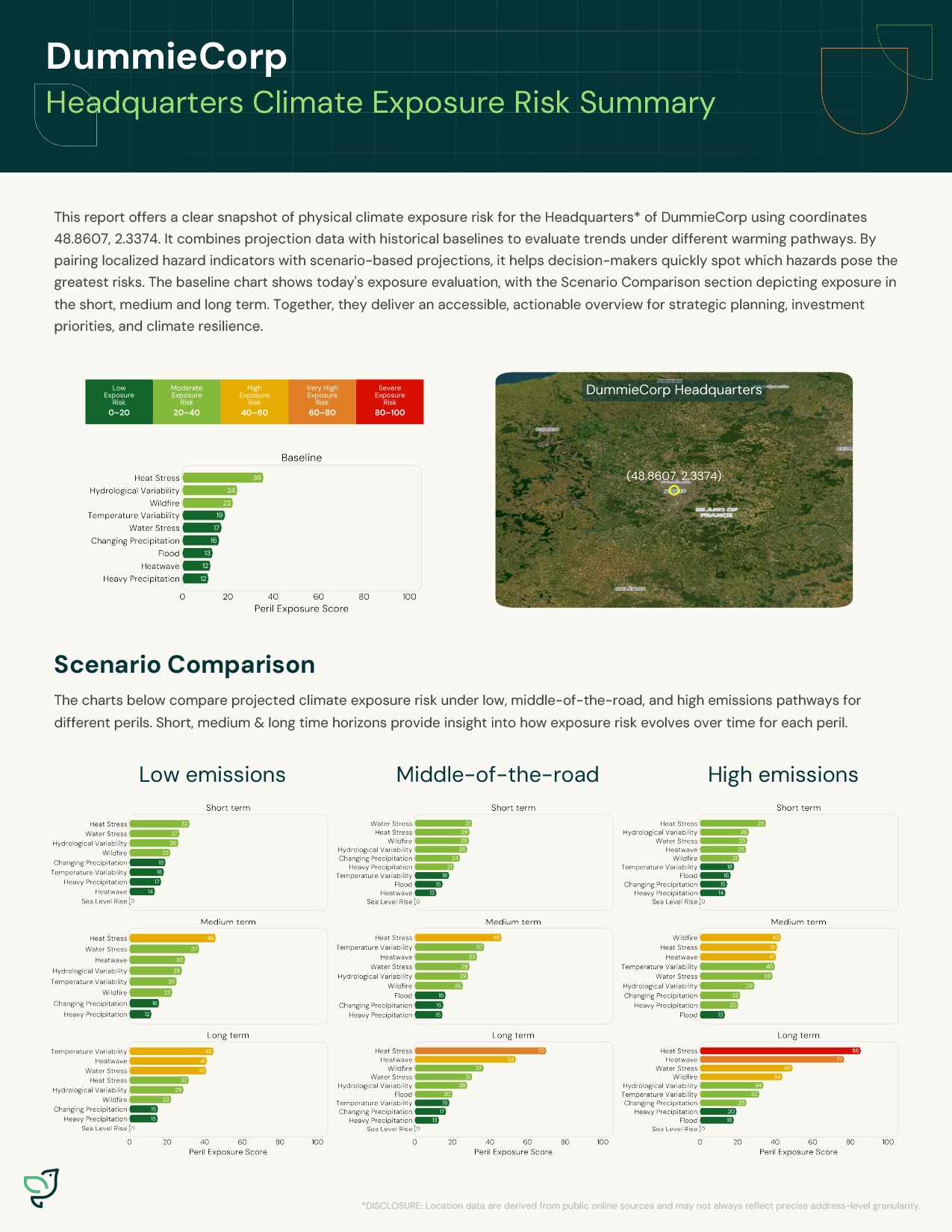
Gain an in-depth understanding of your climate exposure risk under low, middle-of the road AND high emission scenarios.
(Note that the above summary is for illustrative purposes only, and does not reflect real-world entities)
Want to understand your exposure to physical climate risk?