

Use TCFD reporting and disclose with confidence
Collect and calculate your Scope 1, 2, and 3 emissions, automatically formatting them to TCFD specifications.
Where to begin with TCFD reporting?
Keeping track of all four TCFD pillar requirements and having the right systems in place to collect the data you need is a challenge. Not only do you need a deep understanding of Scope 1, 2, and 3 emissions and how to calculate them, but you also need to understand which TCFD climate risks to focus on according to your industry sector and geography.


The risks you might face
Without the right knowledge, you may be collecting inaccurate data which is prone to human error, while using extremely time-consuming processes to carry out your GHG reporting.
Introducing you to our TCFD Software, Powered by Ecometrica
With our TCFD reporting software, you can make sure everything is accounted for with the help of our robust platform and a sustainability expert to guide you along the way.
- Builds a solid foundation with the help of expert support
- Centralizes all data in one platform
- Calculates Scope 1, 2, and 3 emissions with ease
- Identifies climate risks based on your location
- Provides clear results that are audit ready

Comprehensive support for leading sustainability frameworks

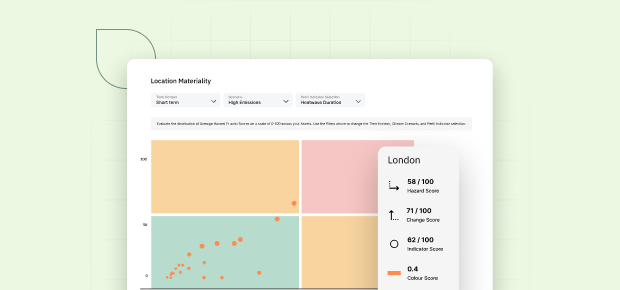
Identify, assess, and report Climate Risk
Climate Risk gives sustainability leaders a faster path to quality physical climate risk data—saving time, reducing complexity, and helping you stay ahead of business risks and evolving frameworks.

Audit-ready EU CSRD reports
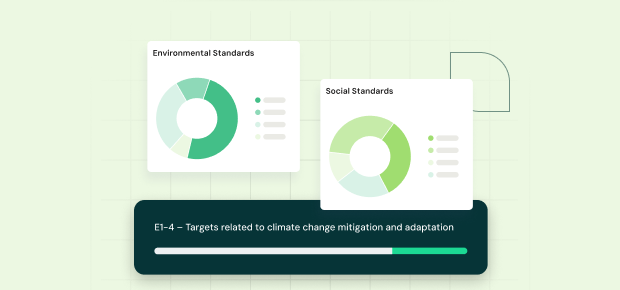
Gain full confidence in the end-to-end process and compliance with CSRD. Manage CSRD data collection quickly and simply, covering the ESRS topics and standards with market-leading data and integrations.

Be ready for California SB 253 & SB 261
Stay ahead of the curve with data you can trust for your California SB 253 and SB 261 reporting requirements.

Comply with SECR
Maintain control of your data and receive robust SECR (Streamlined Energy and Carbon Reporting) figures ready for your annual reporting.

Improve your CDP scores
Master your CDP submissions across the different disclosure schemes using EcoOnline’s sustainability reporting software. Year after year, our customers improve their CDP scores by working with us.

Accurate CSR Reporting
Reporting the positive impact of your business requires data. Our sustainability reporting software offers flexible data collection, analysis and reporting. You can use ready-made questionnaires and metrics, or define your own. Collect data across all geographies without missing data.
Strengthen your sustainability performance with deeper insight
Climate Scenarios
Assess various climate scenarios at the same time to gain greater insight into possible outcomes in the future and how they could affect your business.
GHG Emissions Reporting
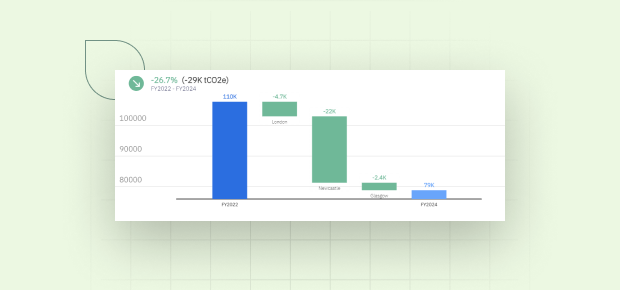
Complete your Scope 1, 2, and 3 emissions with ease using our comprehensive emissions factor database and automated calculations.
Integrated Reporting
Connect data points across all Environmental, Social, and Governance frameworks, including climate risks.
TCFD Risk Assessor Software
Understand the effects of physical risks in terms of heat extremes, drought, flooding, and the rise of sea levels on your organization or supply chain and how to manage them.
“A global environmental platform enables PageGroup to capture environmental data from across the business in a way that requires fewer manual checks, reminders and spreadsheets in the process. The data input will allow us to enhance our external environmental reporting as well as to provide vital insight to our business.”

Joanna Bonnett,
Head of Sustainability, PageGroup plc.

STEP BY STEP
Getting started is simple

Fill out the contact form
We’ll be in touch in the next 24-48 hours on weekdays to schedule a chat with one of our consultants.

Your personalized guided tour
You’ll get concierge-level service, with a customized tour to demonstrate how our software can help.

Start your journey towards a safer workplace
Discover how simple ESG reporting can be when you’ve found the right solution for your organization.

Ready to simplify your TCFD disclosures?
Speak with one of our in-house sustainability experts today and discover how we can help simplify your TCFD disclosure processes, allowing you to stay compliant with reporting requirements.
20+ YEARS OF EXPERIENCE
Trusted by 11,000+ customers worldwide
With knowledge from 90 different industries, we have developed our platform to make sure it tailors to your needs.
Be in the know
Access industry-leading information
Frequently asked questions
Created in 2015 by the Financial Stability Board (FSB), the Task Force for Climate-related Financial Disclosures or TCFD is a reporting framework followed in many regions of the world including the European Union, Canada, and Japan to name a few. Its main goal is to allow organizations to see the impact they have on the environment, allowing them to make more sustainable choices in the future.
TCFD reporting is a standardized framework that organizations should follow when reporting their emissions. This is based on several recommendations according to the TCFD pillars to provide greater clarity to third parties (such as investors), exactly what their greenhouse gas emissions are, management of climate-related risks on their organization, and how they plan to address these in the future.
There are four TCFD pillars: Governance, Strategy, Risk Management, and Metrics and Targets.
Governance: Under the governance pillar, organizations must explain the role of leaders and management when it comes to analyzing and managing climate-related risks and opportunities.
Strategy: Here, all climate-related risks and opportunities must be identified and their impact on the organization, in terms of future plans and finances, must be explained.
Risk Management: The organization must explain how they will manage the climate-related risks identified and their methods for aligning them with the company’s risk management procedures.
Metrics and Targets: Under this pillar, organizations must reveal their GHG emissions values and what metrics and targets were used to analyse the climate-related risks and opportunities.
Yes! This has already been in effect for some companies as of April of 2022, when TCFD reporting became mandatory for all companies located in the United Kingdom with over 500 employees. In 2025, this will become mandatory for all companies.
Greenhouse gases are those which absorb heat from the sun, causing the atmosphere’s temperature to rise. They include carbon dioxide, methane, nitrous oxide, hydrofluorocarbons, peItrfluorocarbons, sulphur hexafluoride, and nitrogen trifluoride. It’s important to be aware of what greenhouse gases your company is emitting by calculating your Scope 1, 2, and 3 emissions.
Greenhouse gas reporting includes your Scope 1, 2, and 3 emissions.
Scope 1 emissions are direct emissions from areas under your company’s control. This includes fuel used for office heating or energy needed to create equipment.
Scope 2 emissions are indirect emissions created from the generation of electricity, heat or cooling.
Scope 3 emissions are all other indirect emissions which include employee commuting, business travel, and waste disposal to name a few.