

Health & Safety

Safety data sheets in North America: 2026 data shows a sharp rise in chemical handling, and a growing substitution gap

Chemical handling in North America just jumped 9 points in a single year, and more workers than ever need instant access to safety data sheets. Our 2026 Workplace Safety Report reveals a region leading the world in digital SDS access and QR code adoption, yet quietly stalling on the harder work of substituting hazardous chemicals. Hereโ€™s what the data means for employers.
kemikaalien kรคsittely laboratoriossa
Back to all
Article
October 2, 2026

Summary

EcoOnlineโ€™s 2026 Workplace Safety Report revealed that chemical handling just saw one of the biggest year-on-year jumps in our entire dataset. More North American workers are handling hazardous chemicals than ever, and while access to safety data sheets is improving fast, the harder work of removing risk at the source is stalling, especially in Canada.

  • Chemical handling surged in 2026: 53% of North American workers now handle chemicals requiring a safety data sheet (USA 56%, Canada 48%), up 9 points from 44% in 2025.
  • Manufacturing leads exposure at 72%, ahead of construction (67%) and utilities (57%).
  • SDS awareness is solid: 77% of chemical handlers know how to locate the relevant safety data sheets, though Canada (71%) trails the USA (79%), a potential WHMIS compliance risk.
  • North America leads the world on digital access, including a major jump in QR code access to SDS (72%, up from 60% in 2025).
  • Substitution is stalling: just 61% say their employer is actively phasing out hazardous chemicals, down from 62%, with Canada sliding backward.

Introduction

Safety data sheets (SDS) are the foundation of workplace chemical safety. They tell workers exactly what theyโ€™re handling, how to do it safely, what to do in an emergency, and how to store hazardous substances correctly. But as more workers come into contact with hazardous chemicals, the pressure on organizations to make that information instantly accessible, and to reduce reliance on dangerous substances altogether, has never been greater.

EcoOnlineโ€™s 2026 Workplace Safety Report reveals a region in transition. North America leads the world on digitizing access to chemical safety information, yet efforts to substitute hazardous chemicals have flatlined, and Canada is beginning to fall behind on several key measures.

Canada chemical safety at a glance

Metric USA

Hanlde chemicals required an SDS

48%

Know how to locate relevant SDS

71%

Everyone has access to safety info via a digital system 

69%

Access to a digital chemical management system 

64%

Can access SDS via QR code

61%

Active hazardous chemical substitution (2026) 

58%

Table of contents

Click on a specific section below to navigate to that area:


Chemical handling has jumped sharply

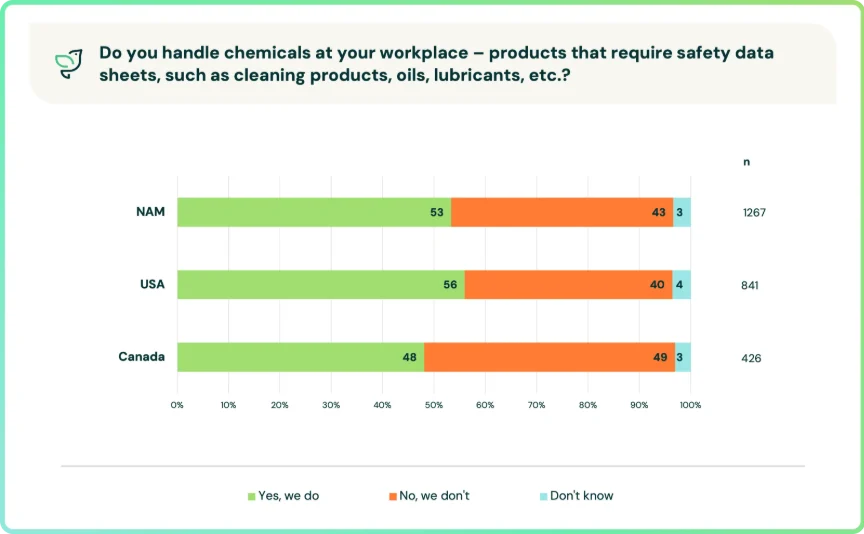
Chemical handling saw one of the biggest year-on-year shifts. In 2026, 53% of North American workers report handling chemicals at work that require a safety data sheet (USA 56%, Canada 48%). Thatโ€™s up from 44% in 2025; a 9-percentage-point jump that moves chemical safety from a significant concern to an unavoidable operational reality.

image

A shift of this size in a single year is rare. Whether it reflects changes in industrial activity, better awareness of what qualifies as a hazardous substance, or more honest reporting, the practical implication is the same: more workers need fast, reliable access to safety data sheets, and the systems that manage them can no longer be an afterthought.


Which industries handle the most chemicals?

As in previous years, manufacturing workers accounted for the largest proportion of those handling chemicals across the region at 72%, compared with:

These are sectors where hazardous chemicals are woven into daily operations, from solvents and adhesives to cleaning agents, coatings, and process chemicals. In high-exposure environments like these, the difference between a well-managed and a poorly managed SDS system is measured in incidents avoided. Centralized chemical management software is especially valuable here, giving safety teams a single, accurate view of every substance across every site.


Do workers know where to find safety data sheets?

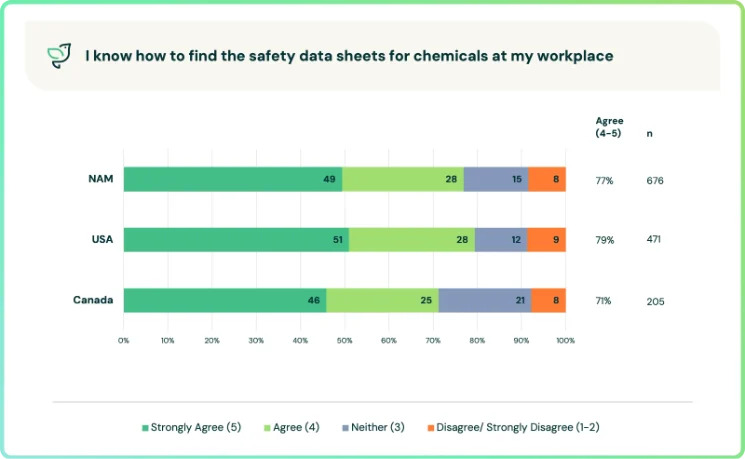
Among those who handle chemicals, 77% of North American workers know how to locate the relevant safety data sheets (USA 79%, Canada 71%). These figures represent a solid baseline of SDS awareness across the region.

image

However, the gap between the two countries bears monitoring. Unfamiliarity with SDS in Canada may create compliance risk, particularly under WHMIS (Workplace Hazardous Materials Information System) obligations. WHMIS requires that workers be informed about, and able to access information on, the hazardous products they work with. When nearly three in ten Canadian chemical handlers arenโ€™t confident about where to find an SDS, thatโ€™s a gap worth closing quickly. A dedicated SDS management system is one of the most direct ways to do it.


North America leads the world on digital access

Hereโ€™s where the region shines. North America sits well above global benchmarks when it comes to digitizing access to chemical safety information. Among chemical handlers:

  • 70% agree everyone at their workplace has access to chemical safety information through a digital system (USA 70%, Canada 69%), compared to a global average of 62%.
  • 65% have access to a digital chemical management system (USA 66%, Canada 64%), compared to a global average of 54%, and notably above the Nordics at 48%.
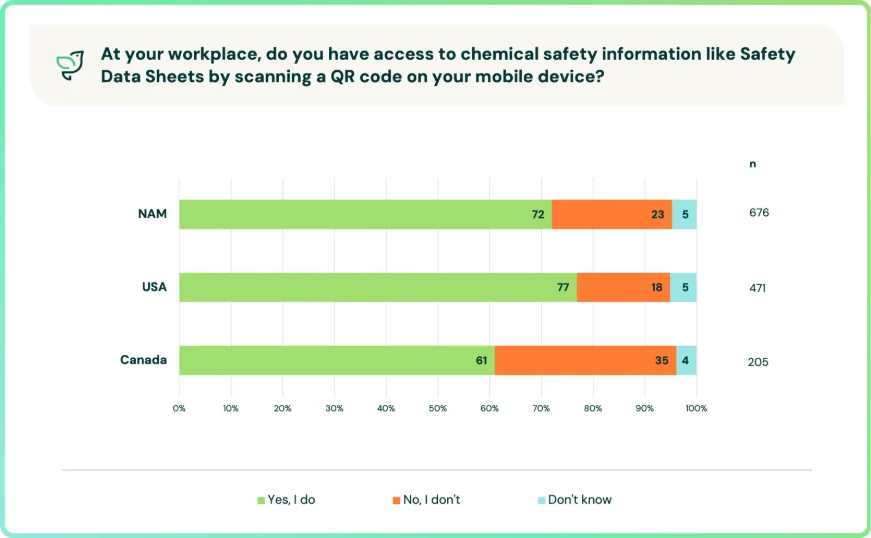
  • 72% can access safety data sheets by scanning a QR code (USA 77%, Canada 61%), up sharply from a 60% North American average in 2025 and above the current global average of 58%.
image

This is a genuine strength. Digital access means that when a worker faces a spill, an exposure, or an unfamiliar substance, the safety data sheet is a click or a scan away, not buried in a binder.

Why digital access to safety data sheets matters

A safety data sheet only protects people if itโ€™s available at the exact moment itโ€™s needed. Modern safety management software centralizes every SDS, keeps it automatically up to date, and makes it instantly reachable from any device. This turns chemical safety information from a static filing requirement into a living, on-demand resource.


The QR code story: a tale of two countries

The QR code figure tells an especially interesting story at the countryโ€™s level. The USA jumped from 59% access in 2025 to 77% in 2026, an 18-point increase in a single year, while Canada held steady at 61%.

That divergence is worth attention. The reasons behind Canadaโ€™s slower uptake may include differences in mobile network coverage across a more geographically dispersed population and industrial base. Whatever the cause, the gap is significant enough that organizations operating across both markets should take note, particularly those standardizing safety processes across US and Canadian sites.

QR-enabled SDS access is one of the highest-impact, lowest-cost tools available in chemical safety. By linking a physical container or workspace directly to its digital safety data sheet, it puts critical hazard information into a workerโ€™s hands in seconds, no logins, no searching, no delays.


Hazardous chemical substitution is stalling, and Canada is falling behind

Despite strong digital access scores, the substitution of hazardous chemicals, the process of proactively replacing dangerous products with safer alternatives, is an area of real concern.

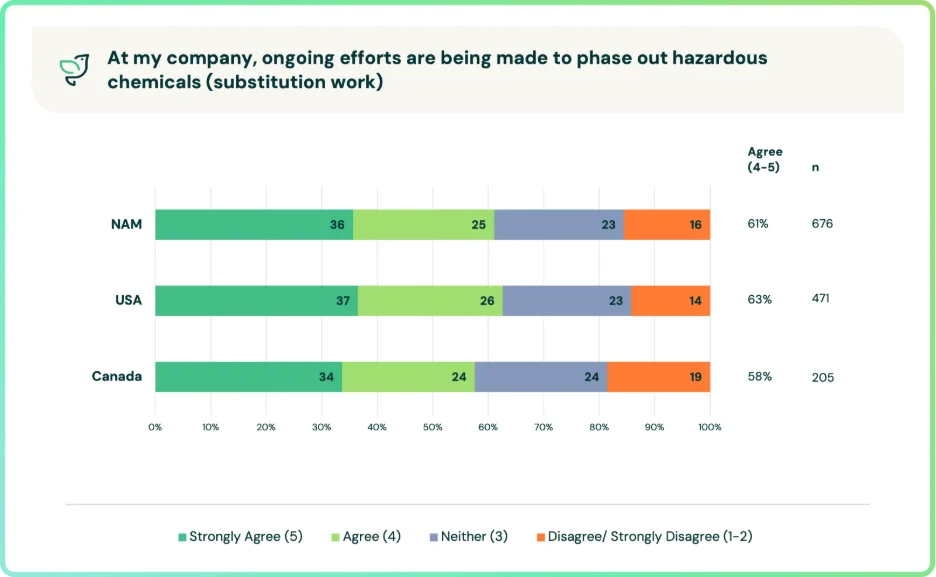
Across North America, 61% of chemical handlers agree their company is making ongoing efforts to phase out hazardous chemicals (USA 63%, Canada 58%), down from 62% in 2025.

The country-level trend is telling:

United States

  • 2025: 60%
  • 2026: 63% (improving)

Canada

  • 2025: 64%
  • 2026: 58% (declining)
image

Canadaโ€™s score has fallen compared to 2025, widening the gap with the USA and reversing what had been a national lead. The overall picture for chemical safety across the region is one of improving visibility and access but stalling on the harder work of removing risk at the source.

This matters because substitution sits at the very top of the hierarchy of controls, above engineering controls, administrative measures, and PPE. This is because it eliminates a hazard entirely rather than merely managing it.

Digital access helps workers cope with hazardous substances; substitution removes them from the equation altogether. Purpose-built chemical substitution software makes it easier to compare safer alternatives, document the process for regulators, and keep substitution efforts moving forward.


What this means for employers

The 2026 data points to three clear priorities for organizations across North America:

1. Scale your SDS systems to match rising chemical handling

With chemical handling up 9 points in a single year, SDS management canโ€™t be manual or fragmented. A centralized, cloud-based library within dedicated safety management software ensures every safety data sheet stays current, compliant, and instantly available as exposure grows.

2. Close the Canada gap, especially on SDS awareness and QR access

Canadian sites trail on SDS awareness (71% vs 79%) and QR code access (61% vs 77%). Targeted action, QR-enabled access at the point of use and clear WHMIS-aligned training, can bring Canadian operations in line with their US counterparts.

3. Reignite chemical substitution programs

With substitution flat overall and declining in Canada, now is the time to revisit your chemical inventory, flag high-risk substances, identify safer alternatives, and track progress over time. Removing a hazard is always more effective than managing it.


In the endโ€ฆ

North Americaโ€™s 2026 chemical safety story is one of two speeds. On access and visibility, the region is a global leader; digital systems are widespread, QR code adoption is surging, and SDS awareness is strong. But on the harder, more consequential work of substituting hazardous chemicals, momentum has stalled, and Canada is slipping backward.

The lesson for employers is that access and elimination are not either/or. Making safety data sheets instantly available protects workers today; substituting hazardous substances protects them permanently. Organizations that pair modern, digital chemical safety systems with a renewed commitment to substitution will be the ones that turn rising chemical handling from a growing liability into a well-managed, well-documented strength.

Because as more workers than ever reach for hazardous chemicals, the safety data sheet that reaches them first, and the safer alternative that replaces the hazard entirely, are what keeps them safe.

Check out our 2026 Workplace Safety Report to find out more.


Frequently asked questions

What is WHIMIS and how does it relate to safety data sheets?

WHMIS (Workplace Hazardous Materials Information System) is Canadaโ€™s national standard for communicating hazardous product information. It requires that safety data sheets be available for hazardous products and that workers are trained to access and understand them. The 2026 data showing 71% SDS awareness among Canadian chemical handlers highlights why WHMIS-aligned access and training remain critical.

Why did chemical handling rise so sharply in North America in 2026?

The report recorded a 9-percentage-point jump, from 44% in 2025 to 53% in 2026, in workers handling chemicals that require a safety data sheet. A shift this large in a single year can reflect changes in industrial activity, greater awareness of what counts as a hazardous substance, or more accurate reporting. Whatever the driver, it means more workers need immediate, reliable access to SDS than ever before.

Which industries handle the most hazardous chemicals?

According to the 2026 data, manufacturing has the highest proportion of chemical handlers at 72%, followed by construction at 67% and utilities at 57%. These sectors rely heavily on solvents, adhesives, coatings, cleaning agents, and process chemicals, making robust SDS management and clear hazard communication especially important.

How do QR codes improve access to safety data sheets?

QR codes link a physical container or workspace directly to its digital safety data sheet, giving workers instant access with a single scan, no logins or searching required. In 2026, 72% of North American chemical handlers could access SDS via QR code, up from 60% the year before, though adoption varies widely between the USA (77%) and Canada (61%).

Why is there a gap between the USA and Canada on chemical safety?

While both countries score similarly on broad digital access, Canada trails the USA on SDS awareness (71% vs 79%), QR code access (61% vs 77%), and hazardous chemical substitution (58% vs 63%). Contributing factors may include differences in mobile network coverage across Canadaโ€™s more dispersed geography and slower uptake of newer digital tools, gaps that organizations operating across both markets should actively monitor.

What is hazardous chemical substitution, and why is it stalling?

Substitution is the practice of replacing a hazardous chemical with a safer alternative, and it sits at the top of the hierarchy of controls because it removes risk at the source. In 2026, only 61% of North American chemical handlers said their employer was actively phasing out hazardous chemicals, down from 62%, with Canada declining from 64% to 58%. The trend suggests organizations are improving access to safety information faster than they are eliminating the underlying hazards.