

Employee safety in North America: What EcoOnline’s 2026 data tells us

Summary
EcoOnline’s 2026 Workplace Safety Report found:
- 80% of North American workers believe their workplace is safe.
- 70% acknowledge employer efforts to address workplace environment issues and involve staff.
- 77% consider physical safety important when choosing an employer.
- 78% say a poor workplace environment could cause them to change jobs.
- 47% say they or a relative have been affected by a workplace accident or work-related illness.
- Among those affected, 56% identify stress as a contributing factor.
- 73% say their employer made efforts around physical hazard assessment, up dramatically from 58% in 2025.
- Only 61% report employer efforts to prevent stress.
- 38% want more people working specifically in safety.
- 31% want better access to digital tools for safety information and reporting.
There is clear progress in some areas, particularly physical hazard assessment; but the results also show where employers still have work to do.
Introduction
Employee safety remains a priority for workers across North America, but EcoOnline’s 2026 Workplace Safety Report reveals a more complicated story beneath the surface.
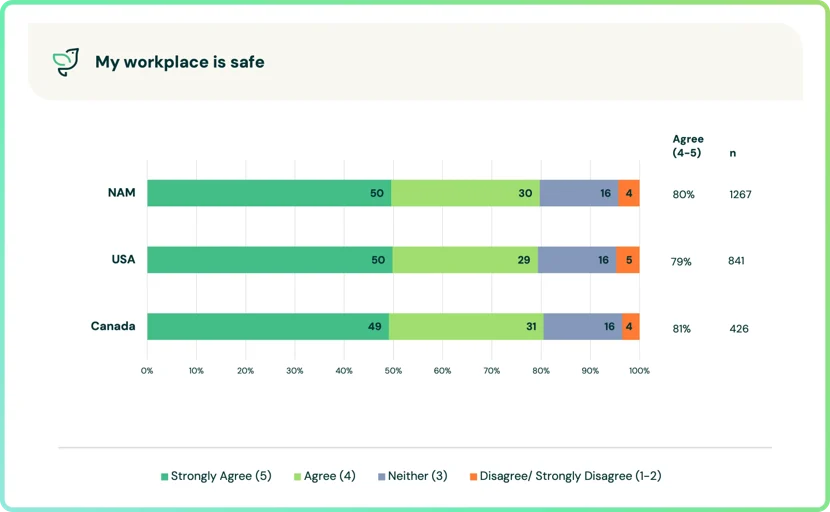
80% of North American workers agree or strongly agree that their workplace is safe, including 79% in the USA and 81% in Canada. That’s encouraging, but the regional result has edged down from 81% in 2025.
At the same time, almost half of North American respondents say that they or a relative have been affected by a workplace accident or work-related illness. Stress remains a leading concern, while workers are asking employers for more safety expertise, more training, and better access to digital safety tools.
So, what does employee safety really look like in 2026?
The findings suggest that creating a safe workplace requires organisations to look beyond physical hazards alone. Employee workplace safety increasingly encompasses the physical, mental, and social conditions people experience at work, as well as the systems organisations put in place to identify and manage those risks.
Table of contents
Click on a specific section below to navigate to that area:
- 1. What is employee safety?
- 2. Safety confidence remains high, but it is moving in the wrong direction
- 3. Workplace safety can influence where people choose to work
- 4. Almost half of workers have a personal connection to workplace accidents or illnesses
- 5. Official workplace safety data adds further perspective
- 6. Stress is emerging as a critical workplace safety issue
- 7. Employers are making significant progress on physical hazard assessment
- 8. But stress prevention still sits at the bottom of the list
- 9. What do North American workers want employers to do about safety?
- 10. How can employers improve employee safety?
- 11. What could better investment in workplace safety deliver?
- 12. Employee safety needs to evolve with the risks workers face
- 13. Employee safety FAQs
What is employee safety?
Employee safety means protecting workers from workplace conditions and hazards that could cause injury, illness, or other harm, while creating systems that identify, assess, report, control, and learn from workplace risks.
Traditionally, defining safety in the workplace might bring physical workplace hazards immediately to mind: machinery, hazardous chemicals, slips and falls, ergonomics, electrical risks, or other sources of injury.
Those risks remain critical. But the idea of a safe workplace is broader.
For EcoOnline’s 2026 survey, the workplace environment means everything affecting how people feel at work:
- Physically
- Mentally
- Socially
That broader definition is especially important when we look at what North American workers are experiencing.
Safety confidence remains high, but it’s moving in the wrong direction
There’s plenty of positive news in the latest results.
80% of workers across North America agree or strongly agree that their workplace is safe.
Broken down by country:
- USA: 79%
- Canada: 81%

But the year-over-year comparison deserves attention. In 2025, 81% of North American workers said they felt safe at work, including 80% in the USA and 82% in Canada.
Each result has slipped by one percentage point.
Employer engagement tells a similar story. 70% of North American workers acknowledge efforts by their employers to address workplace environment issues and involve employees, including 69% in the USA and 71% in Canada.

Neither trend suggests a crisis in confidence, but they do reinforce why organizations can’t take a positive safety culture for granted.
Employee safety requires continuous attention.
Workplace safety can influence where people choose to work
The case for employee safety extends beyond regulatory compliance and incident prevention.
For many workers, safety at work is part of the decision to join an organization in the first place.
EcoOnline found that 77% of North American employees consider the physical safety of the work environment important when choosing an employer.
Canadian workers place particularly strong importance on it:
- USA: 75%
- Canada: 81%

The consequences can extend to retention.
78% of North American workers agree that a poor workplace environment could cause them to change jobs, rising to 80% in Canada and standing at 76% in the USA.
That puts workplace safety alongside wider considerations about employee experience.
Investing in safe working conditions sends a message about what an organization values. Conversely, a poor work environment can become one more reason for good employees to look elsewhere.
Almost half of workers have been affected by a workplace accident or illness, or know someone who has
Perhaps one of the starkest findings is just how close workplace accidents and illnesses are to people’s everyday lives.
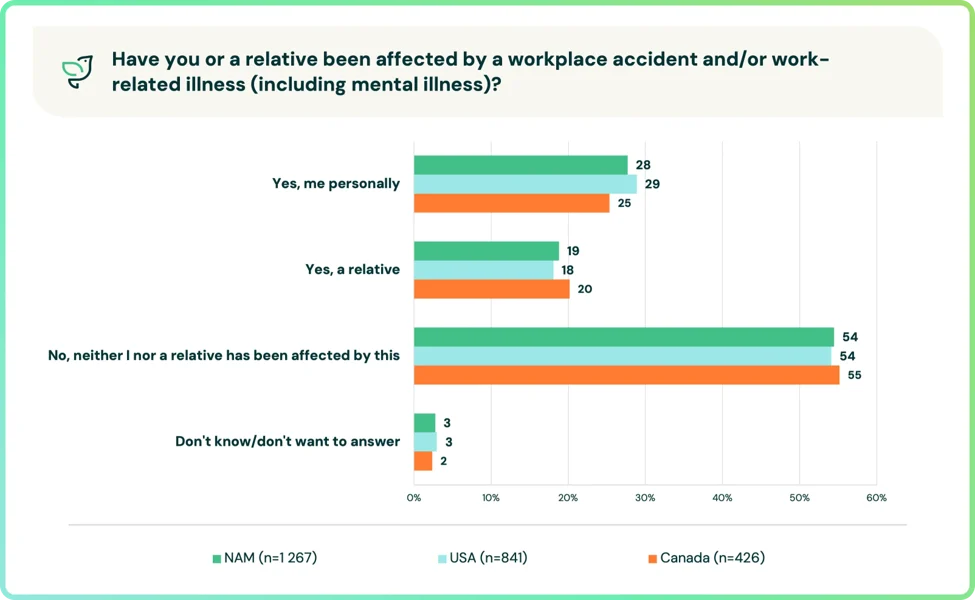
47% of North American respondents say that they or a relative have been affected by a workplace accident or work-related illness.
Of those respondents:
- 28% experienced one personally
- 19% experienced it through a relative

That’s slightly higher than the 46% recorded in EcoOnline’s 2025 survey.
Personal experience was also marginally higher among USA respondents, at 29%, compared with 25% in Canada.
Age exposes another important difference. Among workers aged 18 to 34, 56% say they or a relative have experienced a workplace accident or illness, compared with 51% of 35 to 49-year-olds and 30% of 50 to 65-year-olds.
These findings make employee safety much more than an abstract organizational concept. For a substantial proportion of respondents, workplace harm is something they have experienced within their own lives or families.
Official workplace safety data adds further perespective
National data helps put those personal experiences into context.
In the United States, the U.S. Bureau of Labor Statistics recorded 5,070 fatal work injuries in 2024, down 4% from 5,283 in 2023. That equates to one worker dying from a work-related injury every 104 minutes. The fatal injury rate was 3.3 per 100,000 full-time equivalent workers.
The U.S. Bureau of Labor Statistics also reported 2,488,400 nonfatal workplace injuries and illnesses among private-industry workers in 2024, with a total recordable case rate of 2.3 per 100 full-time workers.
Canada’s figures tell their own story. The Canadian Centre for Occupational Health and Safety, citing the Association of Workers’ Compensation Boards of Canada, reports 1,057 recorded workplace fatalities in 2023, along with 274,022 accepted lost-time claims related to workplace injury or disease.
Importantly, Canadian compensation statistics aren’t a complete measure of every workplace injury. The Canadian Centre for Occupational Health and Safety explains that these reports include accepted lost-time and permanent-disability claims rather than every workplace injury.
Taken together, these figures reinforce why continuing to improve employee workplace safety matters, even when most employees say they feel safe.
Stress is emerging as a critical workplace safety issue
Employee safety also can’t stop at physical risk.
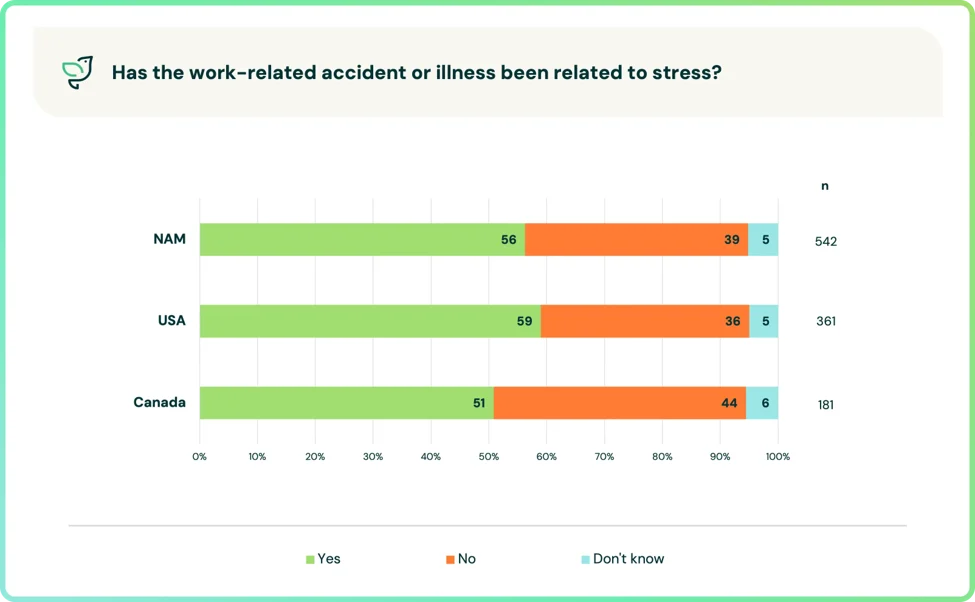
Among North American respondents who experienced or knew someone who experienced a workplace accident or work-related illness, 56% identified stress as a contributing factor.
The country-level findings are particularly interesting:
- USA: 59%
- Canada: 51%

And that’s almost a mirror image of EcoOnline’s 2025 results. Last year, 68% of Canadian respondents in this affected group identified stress as a contributing factor, compared with 44% in the USA. It’s one of the most significant country-level changes in this year’s findings.
External research underlines the broader business implications. The American Institute of Stress estimates that job stress costs US industry approximately $300 billion annually, citing losses associated with factors including absenteeism, turnover, healthcare costs, and lost productivity.
Canada has also formalized the issue of psychological workplace safety. The Mental Health Commission of Canada describes its National Standard of Canada for Psychological Health and Safety in the Workplace as a voluntary framework designed to help organizations promote psychological health and prevent psychological harm at work.
These issues don’t replace traditional occupational safety concerns. They expand the conversation about what workplace safety means.
Employers are making significant progress on physical hazard assessment
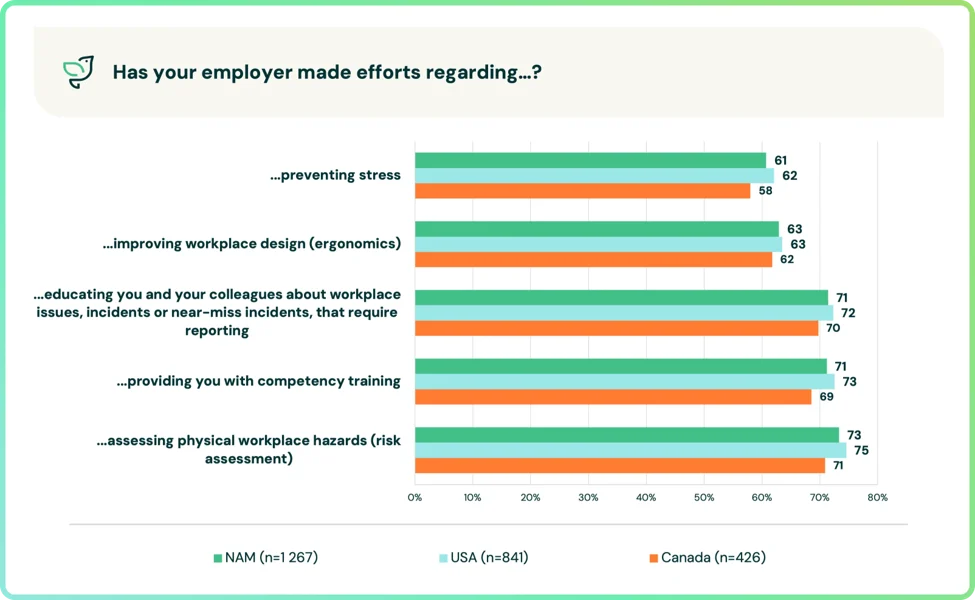
One of the most encouraging findings in the entire North American dataset is the change in workplace risk assessment. In 2025, 58% of North American respondents said their employer was making efforts around physical hazard assessment. In 2026, that figure jumped to 73%.
That’s a substantial 15-percentage-point increase in just one year, moving physical hazard assessment from last place among the five surveyed areas to first.
Country-level findings are similarly positive:
- USA: 75%
- Canada: 71%

Other core safety practices improved too.
Education about workplace issues, accidents, and near misses requiring reporting rose from 68% to 71%, while competency training increased from 69% to 71%.
Together, the findings suggest employers are increasing their focus on some of the fundamentals of effective safety management: understanding hazards, developing workforce competency, and increasing awareness around incidents and reporting.
But stress prevention still sits at the bottom of the list
Here is where the disconnect becomes hard to ignore.
Among respondents affected directly or indirectly by workplace accidents or illnesses, stress was identified as a contributing factor by 56%; yet, only 61% of North American workers say their employer has made efforts to prevent stress.
Compare that with the other safety areas measured:
- Physical hazard assessment: 73%
- Competency training: 71%
- Incident awareness education: 71%
- Ergonomics improvement: 63%
- Stress prevention: 61%
The result is even lower in Canada, at 58%, compared with 62% in the USA.
Employers have clearly become more active around physical risk assessment. The next step is building an equally mature approach to psychological hazards and workplace stress.
In Canada, for example, federal guidance explicitly advises federally regulated employers to assess workplaces for physical and psychological hazards and develop plans to address and mitigate them.
The Mental Health Commission of Canada’s Workplace Standard similarly uses a management-systems approach to help organizations identify psychosocial hazards, assess and manage risks, and implement measures intended to prevent psychological harm.
In other words, mental and physical safety don’t have to operate as two separate strategies.
What do North American workers want employers to do about safety?
The survey gives employers some particularly useful answers.
The most common request is simple: more safety expertise.
38% of North American workers want employers to ensure more people work specifically on safety, either through dedicated hires or by training existing employees into safety roles.
The results are remarkably consistent:
- USA: 38%
- Canada: 39%
Next comes training.
36% of North American respondents want more safety training for all staff, including 35% in the USA.

In Canada, that figure climbs to 40%, making additional safety training the country’s number-one requested improvement.
But the third result is especially noteworthy for organizations working to modernize their approach to health and safety. 31% of North American workers want better access to digital tools for safety information and reporting, including 32% in the USA and 28% in Canada.
Workers aren’t simply asking employers to care more about safety. They’re pointing toward practical resources that can help them participate in it.
How can employers improve employee safety?
The findings suggest several priorities for organizations considering where their employee safety strategy should go next.
1. Keep strengthening workplace risk assessment
The 15-percentage-point rise in employer effort around physical hazard assessment is an encouraging development. Organizations should continue identifying workplace hazards and evaluating controls while ensuring risk assessments reflect the way people actually perform their jobs.
That becomes particularly important in environments involving hazardous chemicals, machinery, ergonomic risk, high-risk work, or changing working conditions.
2. Treat psychological and physical safety as connected
Stress shouldn’t sit outside the core safety conversation.
Organizations can examine psychosocial hazards with the same systematic mindset they apply to physical risk. The Canadian Centre for Occupational Health and Safety, for example, identifies methods including reviewing internal data, auditing relevant workplace policies and practices, and gathering employee feedback when assessing psychosocial hazards.
3. Build competency through workplace safety training
Training is one of the clearest requests from workers, particularly in Canada.
But workplace safety training needs to translate into competency. Employees should understand the hazards relevant to their work, the controls designed to protect them, and how to raise concerns when something doesn’t look right.
4. Make reporting easier
Hazards, near misses, and incidents can provide valuable information about conditions on the ground.
If reporting feels difficult or disconnected from everyday work, important safety information can be harder for safety teams to capture and act on.
This is where digital tools can support a more connected approach to workplace safety. Notably, 31% of North American respondents specifically ask for better access to digital tools for safety information and reporting.
5. Listen to workers
Employee involvement is itself a source of safety intelligence.
The people carrying out tasks every day can often identify where controls work effectively and where gaps exist. Creating clear channels for employee participation can therefore complement formal workplace risk assessments.
What could better investment in workplace safety deliver?
Workers aren’t only telling employers what they want. They’re also identifying what they think greater investment could achieve.
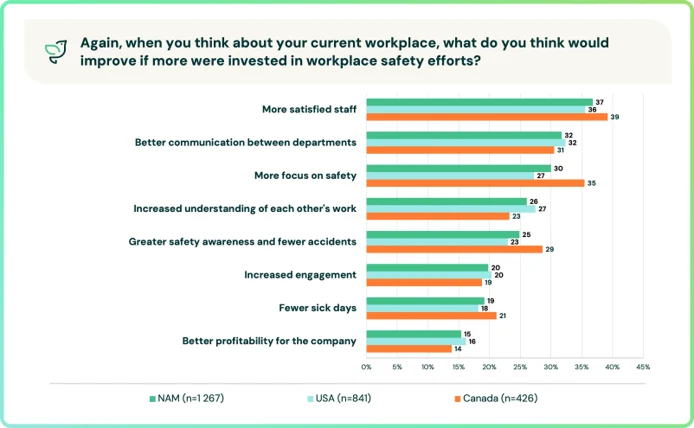
Across North America, respondents say additional investment in workplace safety could result in:
- 37%: more satisfied employees
- 32%: better communication between departments
- 30%: greater focus on safety

Canadian participants consistently selected a higher proportion across many of the potential benefits included in the survey, indicating particularly strong expectations about what additional employer-led safety investment could achieve.
Taken alongside the recruitment and retention findings, the results make the wider value of workplace safety difficult to overlook.
Employee safety needs to evolve with the risks workers face
North American employers have reasons to be optimistic. Four in five employees say their workplace is safe. Employer activity around physical hazard assessment has increased dramatically. Training and incident education are moving in the right direction.
But progress in one area shouldn’t obscure risks elsewhere.
Almost half of respondents have a personal or family connection to workplace accidents or work-related illness. Safety confidence has edged downward, and among affected workers, stress continues to emerge as a major contributing factor even though employer efforts to prevent it rank last among the five areas measured.
The next phase of employee safety therefore shouldn’t be about choosing between physical and psychological safety. Organizations have an opportunity to connect both.
That means identifying hazards, listening to employees, developing competency, making reporting accessible, learning from incidents and near misses, and giving workers the tools they need to participate in workplace safety.
Because ultimately, a strong safety culture isn’t defined simply by whether employees feel safe. It’s defined by how effectively an organization identifies risk and acts before someone gets hurt.
Get more safety insights in EcoOnline’s 2026 Workplace Safety Report today:
Elevate your incident reporting workflow
Book a demo
We’ll take you through exactly how EcoOnline’s EHS software can benefit your business.
Frequently asked questions
Employee safety is the protection of workers from hazards and conditions that could cause injury, illness, or other harm at work. It includes identifying and controlling workplace hazards, providing appropriate training, encouraging hazard and incident reporting, and considering both physical and psychological risks.
Workplace safety refers to the policies, practices, systems, and behaviors used to protect people from work-related hazards and reduce the risk of injury and illness. Effective workplace safety involves identifying hazards, assessing risks, applying appropriate controls, training employees, and learning from incidents and near misses.
Safety in the workplace means creating working conditions where hazards are identified and risks are effectively managed to protect employees’ health and well-being. That includes physical safety as well as consideration of ergonomic and psychological hazards.
Employee workplace safety helps protect workers from injury and illness, but employees also connect it with their experience of an employer. EcoOnline’s 2026 Workplace Safety Report found that 77% of North American workers consider physical safety important when choosing an employer, while 78% say a poor workplace environment could cause them to change jobs.
Workplace hazards vary significantly by industry and occupation, but can include safety hazards, chemical exposures, ergonomic hazards, biological hazards, physical agents, and psychosocial risks. Effective workplace risk assessment should reflect the hazards employees actually encounter rather than taking a one-size-fits-all approach.
Employers can improve safety at work by identifying and assessing hazards, implementing appropriate controls, developing employee competency through training, involving workers in safety discussions, improving incident and near-miss reporting, and considering physical and psychological risks together.
EcoOnline’s 2026 research reinforces several of these priorities: 38% of North American workers want more people working specifically in safety, 36% want more safety training, and 31% want better access to digital safety information and reporting tools.
Health and safety software, like EcoOnline, can help organizations centralize safety information and support processes such as hazard management, incident reporting, risk management, and employee access to safety information.
For North American employers, the digital element is especially relevant: 31% of workers surveyed by EcoOnline want better access to digital tools for safety information and reporting. Giving employees accessible ways to raise concerns and report incidents can help safety teams build a clearer picture of workplace risk and identify areas requiring attention.
Take a look at our demo video library or download our compliance toolkit to get an idea of how we can help protect your people.
About the author
Dina Adlouni
Content Marketing Manager
Dina Adlouni is a Content Marketing Manager at EcoOnline and an expert in EHS and sustainability content. She has been writing about this topic for six years and counting.