

Health & Safety

Employee safety in 2026: Why feeling safe at work is only part of the picture

Employee safety is improving across the UK and Ireland, but EcoOnline’s 2026 Workplace Safety Report reveals important gaps. Explore what workers say about workplace hazards, stress, productivity, and where employers should focus their safety efforts next.
Beredskabsplan skabelon
Back to all
Article

By Dina Adlouni

November 24, 2026

Summary

EcoOnline’s 2026 Workplace Safety Report found:

  • 83% of workers in the UK and Ireland feel their workplace is safe.
  • 72% say their employer involves staff when dealing with workplace environment issues.
  • 90% believe a safer workplace makes them more productive.
  • 79% consider physical workplace safety important when choosing an employer.
  • 76% say a bad work environment could cause them to leave their job.
  • 39% have been affected by a workplace accident or illness or know someone who has.
  • Of this group, 61% say the incident or illness was stress related.
  • 80% say their employers put effort into assessing physical workplace hazards.
  • Only 62% say their employers have made efforts to prevent stress.

The message for employers is clear: progress is being made, but employee safety needs to address physical and psychological risks together.

Introduction

Employee safety is about more than just preventing accidents. A truly safe workplace considers the physical, mental, and social factors that affect people at work, from managing workplace hazards to addressing stress, encouraging incident reporting, and giving employees a meaningful voice in safety decisions.

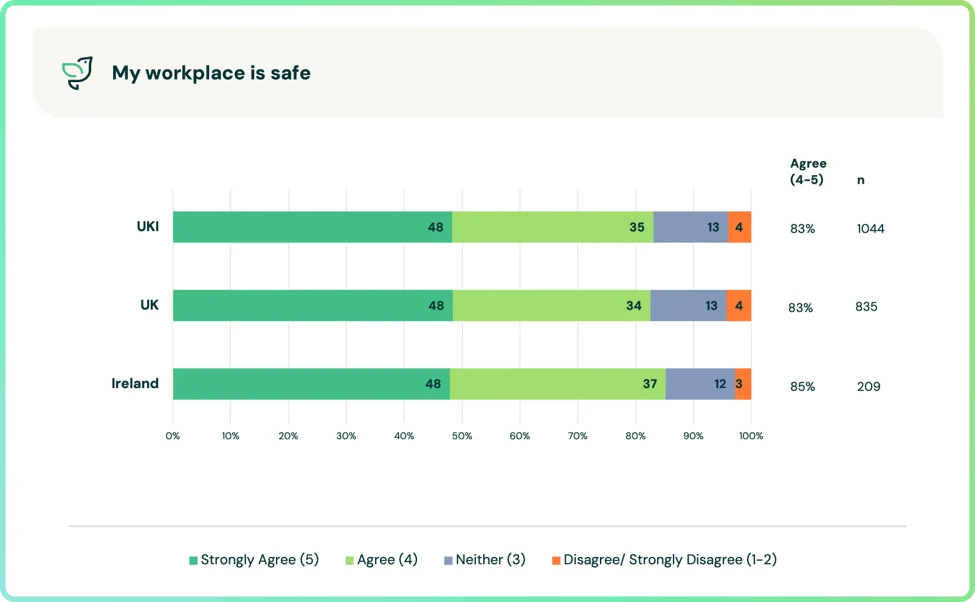
The good news is that most workers believe their workplace is safe. According to EcoOnline’s 2026 Workplace Safety Report, 83% of workers in the UK and Ireland say their current workplace is safe, up slightly from 82% in 2025.

But dig deeper into the data and a more complicated picture emerges.

Stress continues to play a major role in workplace incidents and illnesses. Workers want greater investment in safety expertise and training. Importantly for employers, employees increasingly connect a safer workplace with their ability to do their jobs effectively.

90% of workers in the UK and Ireland believe a safer workplace makes them more productive.

For organisations thinking about employee safety in 2026 and onwards, safety isn’t simply a compliance question. It’s closely connected with workforce wellbeing, retention, engagement, and productivity.

Table of contents

Click on a specific section below to navigate to that area:


What is employee safety?

Employee safety is the protection of workers from physical, psychological, and other workplace risks that could cause injury or ill health. It encompasses identifying workplace hazards, assessing and controlling risks, providing appropriate training and information, reporting and learning from incidents, and creating working conditions that support employees’ health and wellbeing.

That wider definition matters.

For the purposes of EcoOnline’s 2026 survey, the workplace environment includes everything affecting how employees feel at work:

  • Physically
  • Mentally
  • Socially

In Great Britain, health and safety law similarly extends beyond responding to accidents. The Health and Safety at Work etc. Act 1974 places general duties on employers, while the Management of Health and Safety at Work Regulations require arrangements for controlling health and safety risks. HSE also states that employers have a legal duty to protect workers from work-related stress by assessing the risk and acting on it.

In Ireland, the Safety, Health, and Welfare at Work Act 2005 takes a similarly broad approach to workplace risk. Employers must identify workplace hazards and assess the risks they present to employees’ safety and health. The Health and Safety Authority explains that this means considering anything in the workplace that could cause harm, rather than limiting risk assessment to obvious physical hazards.

That makes effective employee safety a matter of prevention as much as response.


Most workers in the UK and Ireland feel safe at work

There are encouraging signs in this year’s findings.

Across the UK and Ireland, 83% of respondents agree that their workplace is safe. In the UK, that figure is 83%, while Ireland reaches 85%.

image

That’s a slight improvement on the region’s 82% result in 2025. Ireland recorded particularly strong progress, rising from 80% in 2025 to 85% in 2026.

The UK and Ireland also lead the regions included in EcoOnline’s survey when workers are asked whether they agree their workplace is safe:

  • UK and Ireland: 83%
  • USA and Canada: 80%
  • Nordics: 76%

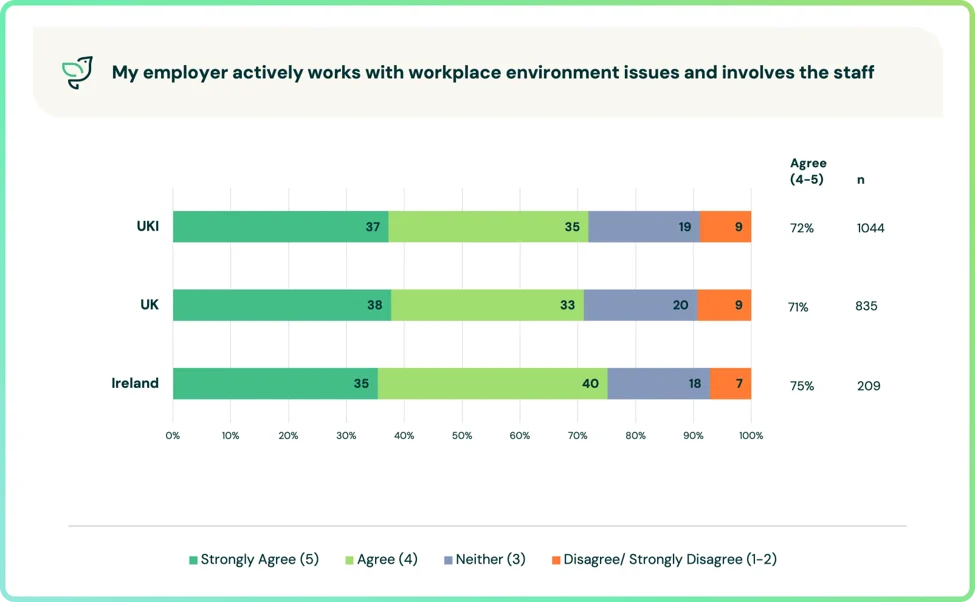
Employee involvement is moving in a positive direction, too. 72% of workers across the UK and Ireland say their employer involves staff when dealing with workplace environment issues, compared with 71% in 2025.

Broken down geographically, that’s 71% in the UK and 75% in Ireland.

image

This involvement matters because employees don’t just encounter risks. They can also provide first-hand insight into where workplace hazards exist and how controls operate in practice.

Indeed, worker consultation forms part of the health and safety framework. HSE notes that UK employers have duties to consult workers or their representatives on health and safety matters.


Why employee safety matters for productivity

One of the standout findings from EcoOnline’s 2026 Workplace Safety Report is how strongly employees connect workplace safety with productivity.

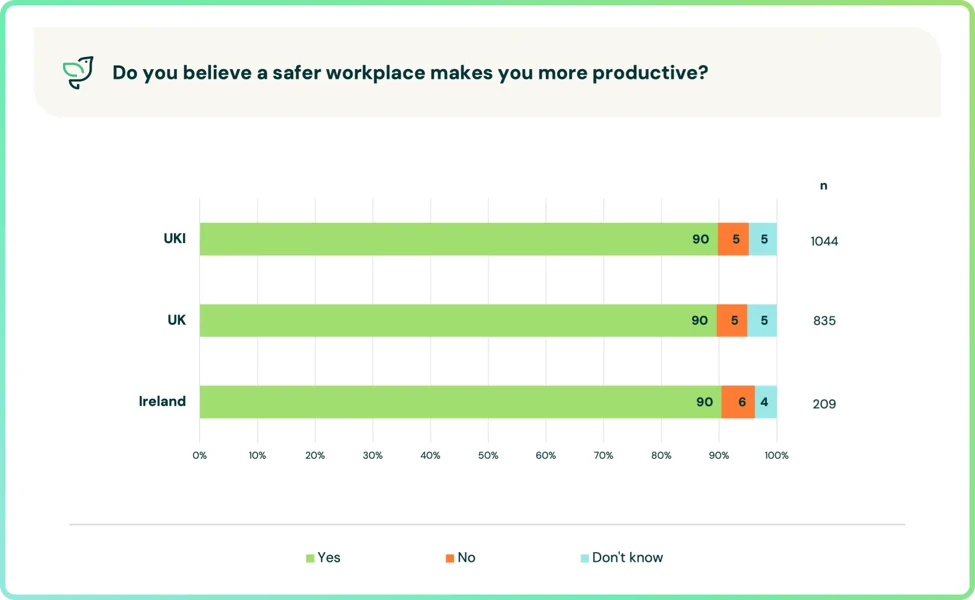
Nine in ten workers in the UK and Ireland believe a safer workplace makes them more productive. That’s an important finding for leaders making the business case for investment in health and safety.

image

Effective safety management can create an environment in which employees can focus on their work rather than navigating uncontrolled risks or concerns about their wellbeing. And workers themselves clearly see the connection.

Safety can influence where they choose to work, too.

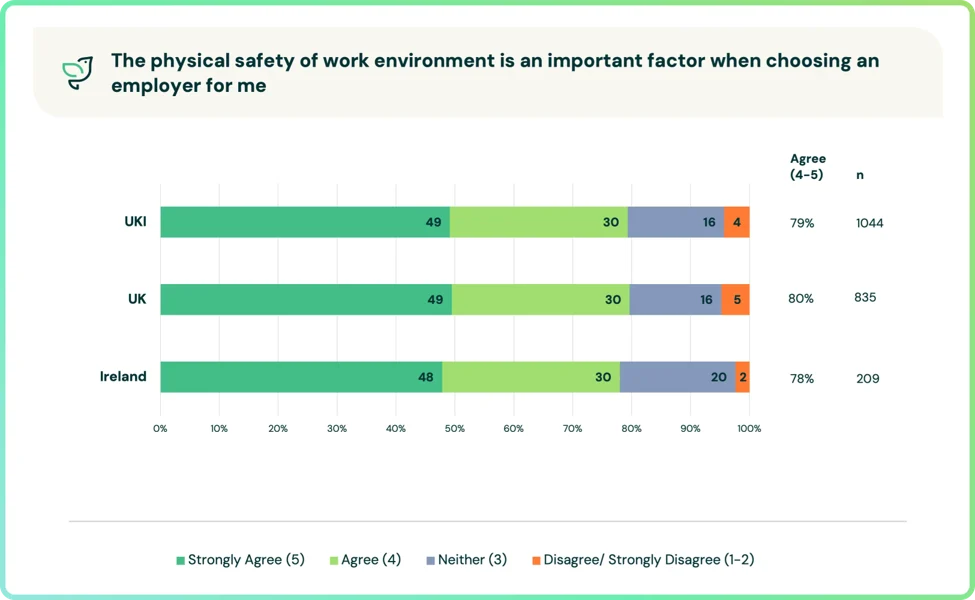
79% of workers in the UK and Ireland consider the physical safety of a workplace an important factor when choosing an employer, including 80% in the UK and 78% in Ireland.

image

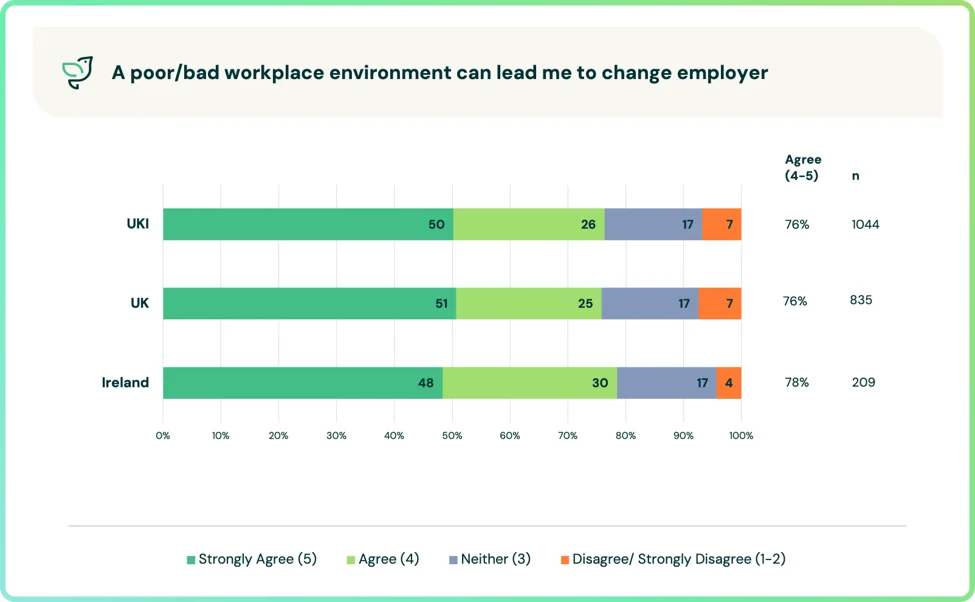
Employee safety can also become a retention issue. 76% of workers surveyed say a bad work environment would give them cause to leave their job.

image

The implication is difficult for employers to overlook: health and safety matters not only because organisations have legal responsibilities, but because workers themselves place considerable value on it.


Workplace incident exposure is falling, particularly in Ireland

The report also provides encouraging signs around workplace accidents and illnesses.

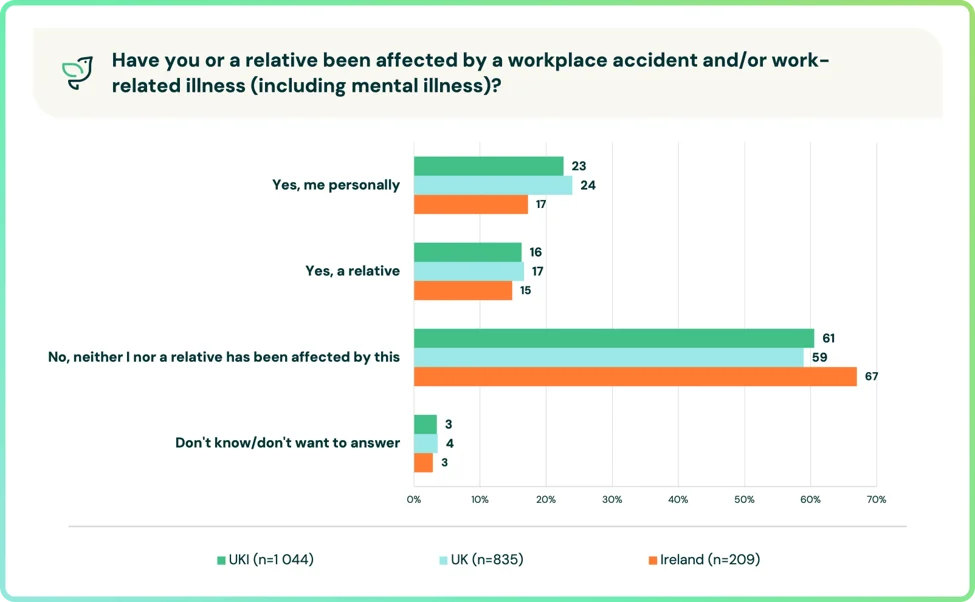
Across the UK and Ireland, 39% of respondents said they had been affected by a workplace accident or illness or knew someone who had.

image

Broken down by country:

  • UK: 41%
  • Ireland: 32%
  • Global average: 49%

Both countries have seen a downward trend compared with last year’s EcoOnline survey, but Ireland stands out. Its figure dropped from 48% in 2025 to 32% in 2026.

National statistics provide another perspective on workplace incidents.

The UK’s Health and Safety Executive recorded 680,000 self-reported non-fatal workplace injuries during 2024/25, alongside 59,219 non-fatal injuries reported by employers under RIDDOR, according to the HSE figures cited in EcoOnline’s report.

In Ireland, Health and Safety Authority figures cited in the report recorded 10,441 non-fatal incidents in 2024, a 3% increase from 2023.

Survey perception and national incident statistics measure different things, so they shouldn’t be treated as directly equivalent. Taken together, however, they reinforce the importance of continuing to identify, assess, and control workplace hazards rather than assuming that positive employee sentiment eliminates risk.


Stress remains one of the biggest employee safety challenges

This is where the picture becomes more concerning.

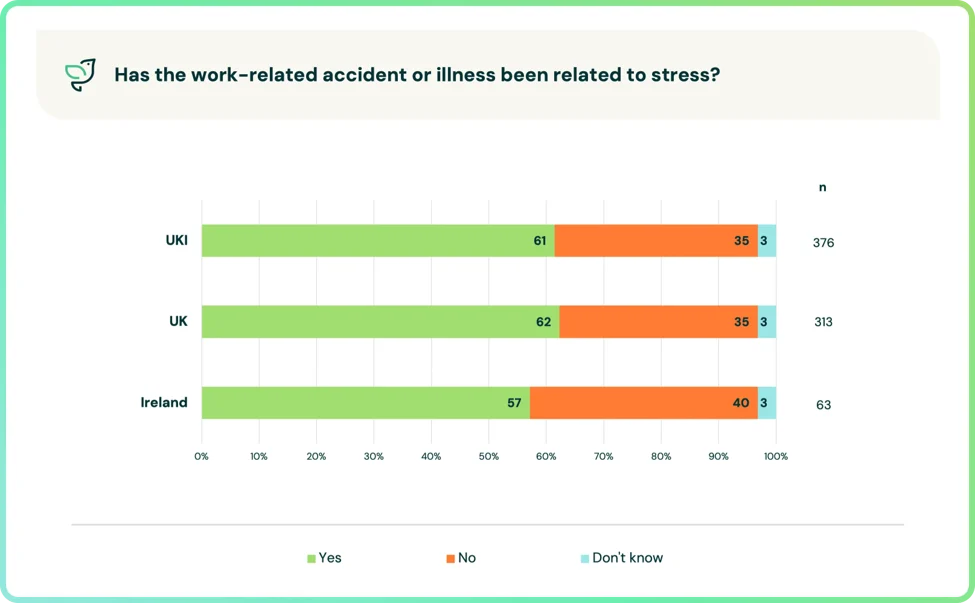
Among UK and Ireland respondents who had been affected by a workplace incident or illness, or knew someone who had, 61% said that stress was a contributing factor.

That figure reaches:

  • 62% in the UK
  • 57% in Ireland
image

The UK and Ireland also recorded the highest percentage for stress as a contributing factor among the regions included in EcoOnline’s global survey:

  • UK and Ireland: 61%
  • USA and Canada: 56%
  • Nordics: 56%
  • Global average: 57%

This isn’t simply a wellbeing issue sitting separately from employee safety.

The HSE says employers have a legal duty to protect workers from stress at work by carrying out a risk assessment and acting on it, assessing its effects on mental and physical health in the same way they assess other work-related health and safety risks.

The HSE’s framework highlights six areas of work design that can affect stress:

  1. Demands
  2. Control
  3. Support
  4. Relationships
  5. Role
  6. Change

And the challenge remains substantial. In October 2026, HSE reported an estimated964,000 workers in Great Britain experiencing work-related stress, depression, or anxiety, accounting for an estimated 22.1 million working days lost.

For employers, this highlights why conversations about workplace hazards should include psychosocial risks alongside more visible physical hazards.


Employers are addressing physical hazards, but stress prevention is lagging

There’s a particularly striking gap in EcoOnline’s findings.

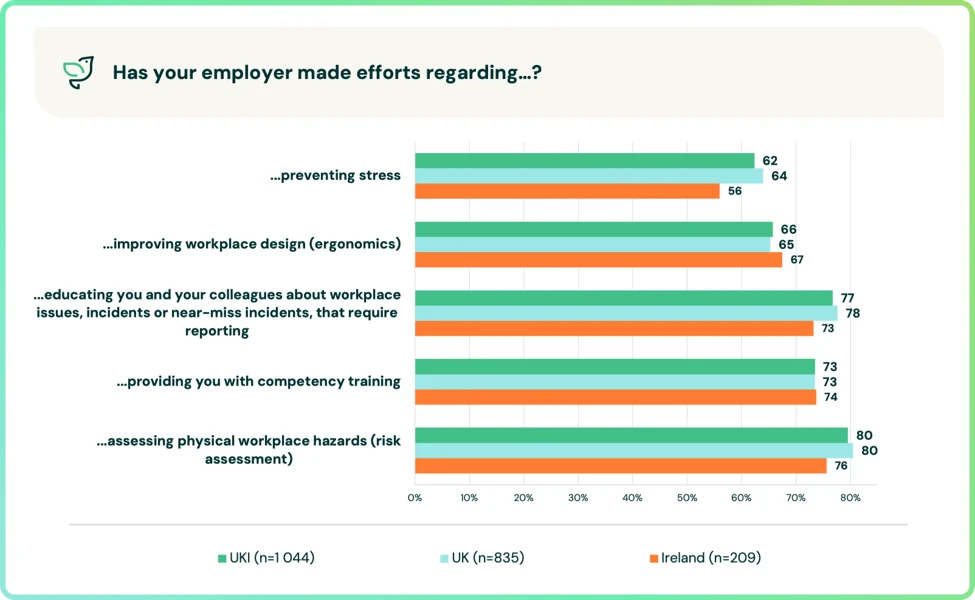
When workers were asked what their employer had done to improve employee safety, 80% said their organisation was putting effort into assessing physical workplace hazards.

Education around workplace issues, including incident reporting, was the second most commonly identified area of improvement.

image

Yet despite stress being the leading contributing cause of workplace incidents and illnesses identified by affected respondents, preventing stress ranked last of the five improvement categories measured in the survey. Only 62% said their employer had made efforts to prevent stress:

  • UK: 64%
  • Ireland: 56%

That reveals an important opportunity.

Organisations have become accustomed to identifying physical workplace hazards. Applying similarly systematic thinking to psychosocial hazards can help close the gap between physical safety and employees’ broader experience of work.

In Great Britain, this approach isn’t just good practice. The HSE explicitly advises employers to assess work-related stress and act on the findings.


What are employees’ responsibilities for health and safety?

This is an important question because employee safety is a shared endeavour, although employers retain significant legal responsibilities for managing workplace risks.

Employee health and safety responsibilities in Great Britain

Under UK health and safety law, employees must take reasonable care of their own health and safety and that of other people who could be affected by their actions. They must also cooperate with employers and colleagues to enable legal health and safety requirements to be met.

The HSE also states that employees should inform their employer of dangerous work situations or shortcomings in safety arrangements and use work equipment correctly in accordance with their training and instructions.

Emplohyee health and safety responsibilities in Ireland

Ireland’s Safety, Health and Welfare at Work Act 2005 establishes responsibilities for employees as well as employers. HSA says employees must, among other responsibilities:

  • Protect their own safety and health and that of people affected by their acts or omissions.
  • Cooperate with their employer on workplace safety, health, and welfare.
  • Participate in safety and health training provided by their employer.
  • Properly use machinery, tools, substances, and personal protective equipment.
  • Report defects that might endanger health and safety.

This makes employee participation important, but it shouldn’t turn into transferring responsibility for controlling risk onto individual workers. Effective employee safety depends on organisational systems that make identifying, communicating, and responding to risks part of everyday work.


What do workers want employers to do differently?

Employees aren’t just identifying shortcomings. EcoOnline’s survey gives us an indication of where they believe additional investment could help.

Priorities differ slightly between the UK and Ireland.

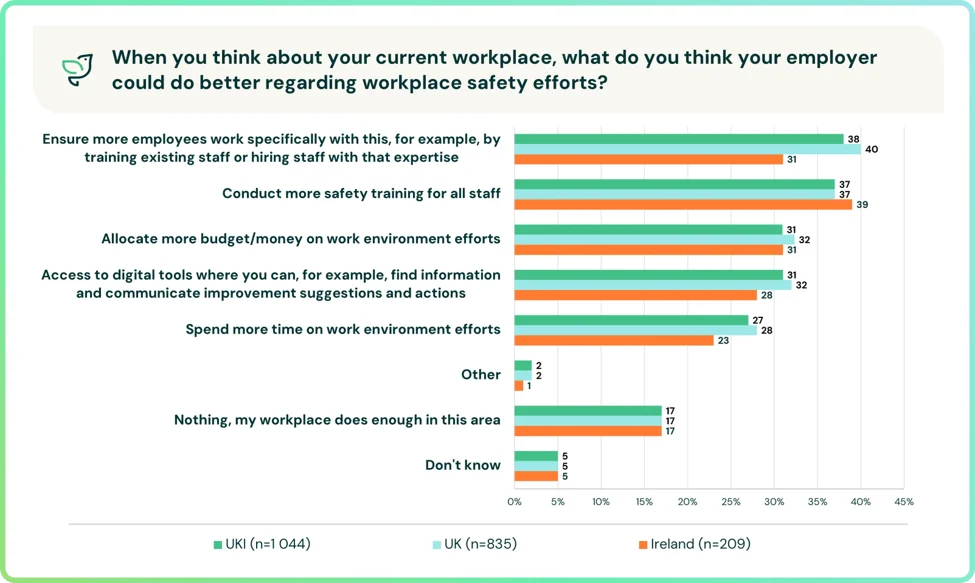
In the UK, 40% of workers want more employees to be hired with safety expertise or more staff working specifically in a safety capacity. In Ireland, 39% want more safety training for all staff.

There’s greater agreement around resources: 32% of UK workers and 31% of Irish workers want more budget allocated to improving the work environment.

image

And what do employees believe organisations could gain from greater investment?

The top anticipated outcomes were:

  • 41%: more satisfied employees
  • 31%: greater focus on safety
  • 29%: better communication between departments
  • 29%: greater safety awareness and fewer incidents

Those responses highlight something important about safety culture. Investment isn’t necessarily experienced by workers as an abstract compliance cost. They associate it with tangible improvements in how people communicate, feel, and work.


How can organisations strengthen employee safety?

The 2026 findings suggest that organisations should resist treating employee safety as a collection of isolated initiatives. A stronger approach connects workplace hazards, employee involvement, incident learning, training, and psychological health.

1. Look beyond physical workplace hazards

Physical hazards remain essential, and 80% of respondents recognise employer effort in this area; but risk management should reflect the full workplace environment.

The HSE’s guidance provides a useful precedent: employers should assess work-related stress just as they assess other health and safety risks.

2. Give employees an active role in safety

With 72% of respondents saying they’re involved in workplace environment issues, many organisations already have a foundation to build on.

Employees often have direct visibility of the hazards, pressures, and working conditions they encounter. Creating accessible ways to report hazards, incidents, and concerns can turn that knowledge into actionable safety information.

3. Make incident reporting part of learning, not just record-keeping

An accident, illness, or near miss can reveal where risk controls need attention. Accessible incident reporting software can support an organisation’s wider approach to recording and managing safety incidents.

4. Treat work-related stress as a safety risk

The most important gap in the survey may be between stress-related incidents and investment in prevention.

When 61% of affected UK and Ireland respondents identify stress as a contributing factor, while stress prevention comes last among the improvement measures surveyed, employers have a clear reason to examine the issue more closely.

Start by bringing psychosocial risks into the organisation’s normal risk-management conversation instead of separating “wellbeing” from “safety.”

5. Strengthen safety expertise and training

Workers themselves identify both expertise and training as priorities. UK respondents most commonly call for more people working specifically in safety, while Irish workers most commonly identify additional safety training.

The exact response will vary by organisation, but the underlying principle is consistent: workers need both capable safety leadership and sufficient knowledge to recognise and respond to risk.


Employee safety is becoming a workforce issue as much as a compliance issue

EcoOnline’s 2026 Workplace Safety Report delivers plenty of good news. Most UK and Irish workers feel safe, employee involvement is improving, and reported exposure to workplace accidents and illnesses in the survey has declined.

But the data also shows why there’s no room for complacency.

Employee safety increasingly intersects with some of the biggest workforce challenges employers face. Workers connect safety with productivity, job choice, satisfaction, and retention. At the same time, stress remains a major contributor to the incidents and illnesses that workers encounter, while employer efforts to prevent it, lag behind measures addressing physical hazards.

For safety leaders, that creates an opportunity to think more broadly about what a safe workplace actually looks like.

A mature approach to employee safety doesn’t choose between protecting physical health and supporting psychological health. It builds systems in which:

  • workplace hazards are identified early
  • workers have a voice
  • incidents produce learning
  • people understand their responsibilities
  • safety becomes part of how work gets done every day

When 90% of workers say a safer workplace makes them more productive, investing in safety isn’t only about preventing something from going wrong. It’s about creating the conditions for people and organisations to perform at their best.

Check out EcoOnline’s Workplace Safety Report for more information on the usage of digital tools in health and safety, chemical safety, lone worker safety, and much more:

Calendar Icon

Frequently asked questions

What is employee safety?

Employee safety refers to the practices, systems, and measures used to protect workers from workplace risks that could cause injury or ill health. It includes managing physical workplace hazards as well as risks such as work-related stress, while providing appropriate information, training, consultation, and ways of reporting safety concerns.

Why is employee safety important?

Employee safety protects people’s health and wellbeing, but its importance extends beyond preventing injuries. EcoOnline’s 2026 Workplace Safety Report found that 90% of workers in the UK and Ireland believe a safer workplace makes them more productive, while 79% consider physical workplace safety important when choosing an employer.

What are the employees’ responsibilities for health and safety?

In Great Britain, workers must take reasonable care of their own health and safety and that of others who may be affected by their actions and cooperate with employers and co-workers to meet legal requirements. In Ireland, employee duties include cooperating with employers, participating in safety training, using equipment and substances appropriately, and reporting defects that may create danger.

What is the Health and Safety at Work Act 1974?

The Health and Safety at Work etc. Act 1974 (HSWA) is the primary legislation governing occupational health and safety in Great Britain. It establishes general duties for employers towards employees and the public, as well as duties for employees towards themselves and others.

What health and safety law applies in Ireland?

Ireland’s principal legislation is the Safety, Health and Welfare at Work Act 2005. It sets out responsibilities for employers, employees, self-employed people, and other parties and covers areas including hazard identification, risk assessment, safety statements, training, consultation, and protective and preventive measures.

Is workplace stress a health and safety issue?

Yes. HSE states that employers have a legal duty to protect workers from work-related stress by carrying out a risk assessment and taking action on the findings. That’s especially relevant given EcoOnline’s 2026 finding that 61% of affected respondents in the UK and Ireland said stress contributed to the workplace incident or illness they experienced or knew about.

What are common workplace hazards?

Workplace hazards depend on the industry and job. They can include physical hazards alongside risks associated with hazardous substances, equipment, manual handling, work at height, and work-related stress. HSE provides dedicated workplace guidance covering areas including COSHH, asbestos, manual handling, work at height, machinery, risk management, and stress.

How can employers improve employee safety?

A strong approach starts with identifying hazards, assessing and controlling risks, consulting employees, providing appropriate information and training, reporting and learning from incidents, and considering physical and psychological health together. The HSE identifies risk assessment, worker consultation, information and training, accident and illness reporting, and competent safety support among its fundamental health and safety measures for employers.

How can software improve employee health and safety?

Health and safety software can improve employee safety by giving organisations a more consistent way to identify workplace hazards, report incidents, manage risks, and keep safety information accessible. Digital tools can also help safety teams bring information together, spot trends in incidents and hazards, and take a more proactive approach to managing employee health and safety. Solutions such as EcoOnline’s incident reporting software can support employees in reporting safety concerns and help organisations turn those reports into opportunities for learning and prevention.
 
Take a look at our demo video library or download our compliance toolkit for more information.

About the author

Dina Adlouni

Content Marketing Manager

Dina Adlouni is a Content Marketing Manager at EcoOnline and an expert in EHS and sustainability content. She has been writing about this topic for six years and counting.