Human factors in incident investigation: How to look beyond “worker error”

Summary
- Your investigation should reconstruct what workers could see, hear, and reasonably know at the time.
- Check six areas, from workload and procedure design to shift handovers and production targets.
- Compare the written procedure with how people do the job on busy, quiet, and short-staffed shifts.
- Link each contributing factor to evidence and look for safeguards that failed or were missing.
- Give corrective actions an owner and test whether they work under the conditions that led to the incident.
Introduction
Imagine a manufacturing facility during its busiest time of day. A vehicle moves before the loading team has cleared the area. The follow-up incident report says “worker error”, but a missed check alone won’t tell you why it could happen again tomorrow.
A human factors incident investigation looks at the task, equipment, and conditions that shaped the decision. It also asks what should have stopped the incident once the check was missed.
This blog will bring you through all the elements of a human factors investigation and help you to choose fixes that address the root cause.
Table of contents
Click on a specific section below to navigate to that area:
What are human factors?
Human factors refers to:
- What people are being asked to do (the characteristics of the task)
- Who is doing it (the individual and their level of competence)
- Where they are working (the organisation and its attributes)
All of the above are also influenced by wider society, on a local and national level.
A missed check might involve an interruption, a notification that suggests the check has already happened, or a gap in the shift handover. Each potential factor needs evidence.
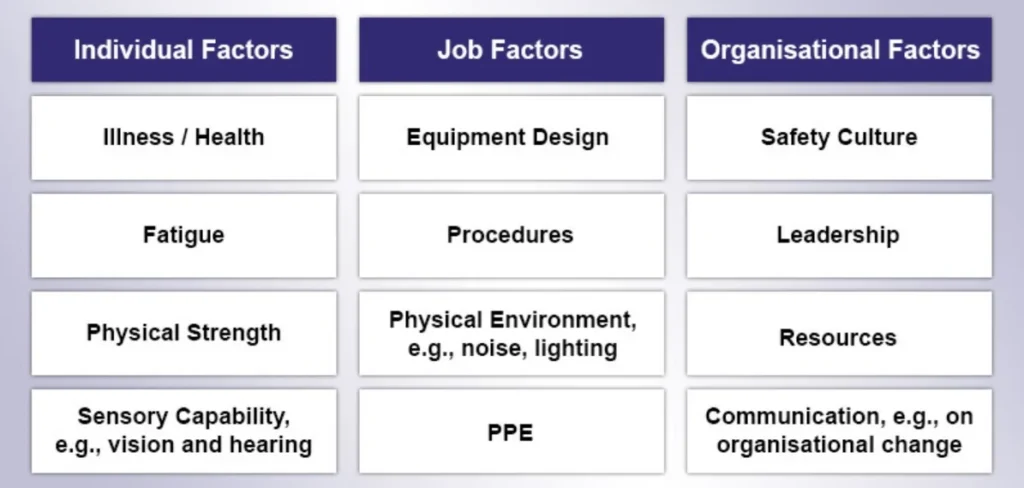
Ireland’s Health and Safety Authority (HSA) sets out how individual, job, and organisational factors influence performance:

Image © Health and Safety Authority (HSA)
Which human factors should you investigate?
Use these six areas to decide what evidence to collect:
| Factor | What to ask | Evidence to check |
|---|---|---|
|
1. Workload and time pressure |
What else was the person handling when the check was due? |
Staffing, overtime, job queues, and the timing of interruptions. |
|
2. Procedure and task design |
Did the written steps match the equipment and the way the task unfolded? Could people complete them during a peak? What does the risk assessment say? |
The version in use, where workers accessed it, and a safe walk-through of normal and busy shifts. |
|
3. Supervision and competence |
Who could help if the task changed? Had workers practised dealing with exceptions? |
Shift cover, escalation records, and observed demonstrations alongside training records. |
|
4. Equipment and workplace design |
What could workers see or hear from their position? What should have prevented exposure if a step was missed? |
Sightlines, alarms, equipment settings, access points, and maintenance records. |
|
5. Shift handovers and communication |
What did the incoming team learn about unfinished work? How did they confirm who owned the next step? |
Handover notes, shift overlap, permits, radio or system records, and accounts from both shifts. |
|
6. Conflicting operational and safety goals |
What happened when someone held up a job because of safety concerns? Which results did managers review? |
Targets, actual delays, escalation decisions, and examples of how supervisors responded to previous stops. |
A handover entry can tell you what someone wrote down. To find out what the next team understood, compare it with what they remember being told and what they checked before taking over. The Health and Safety Executive (HSE) in Great Britain recommends a two-way handover with both a written and verbal exchange.
EcoOnline deep dive – the Ocean Gate Titan submersible implosion
Summary
The result of years of ignored warnings; played out on the global stage.
This documentary explores the 2023 implosion of the Titan submersible, which resulted in the deaths of all 5 people onboard.
How to run a human factors incident investigation
Here are 3 steps to help guide your post-incident investigation, wiht human factors in mind:
Reconstruct the decision made in context
Once the site is safe, preserve evidence such as screen logs, schedules, and the procedure in use at the time. Build a timeline around key decisions and note where the sources disagree.
Interview workers and supervisors separately and ask open questions such as “What could you see from where you were?” and “What usually happens when that screen changes?” Check those accounts against records and physical evidence. For a structured approach to gathering and analysing evidence, see HSE’s investigation workbook.
If you’re starting from a near-miss or incident report, use it to identify the decisions you need to reconstruct. Then establish what the person understood at the time and which options were practical on that shift.
Compare the documented procedure with the work
Walk through the task with people who do it, using a safe demonstration or a simulation where necessary. See if there is a gap in work as imagined vs. work as it‘s done. Include an experienced worker and someone who joined the team recently.
Compare a routine run with an incomplete order at handover. Look for steps that rely on informal knowledge or a supervisor who may be covering another area. In an Irish food manufacturing plant, for example, an investigation into an unexpected start-up could compare the written restart check with the way hygiene, maintenance, and production actually hand the line back to each other.
Ask each team what it checks, what it records, and who confirms everyone is clear. The HSA’s task analysis guidance can help the team walk through those steps and feed the findings into the risk assessment.
Connect the evidence to the controls
Separate the event from the conditions that influenced it. An early vehicle release, as in our introduction, is the event. A misleading status screen is a contributing factor if it influenced the release. A missing independent release control is a safeguard gap.
If a busy shift coincided with the incident, but you can’t establish how it changed the work, record workload as a possible factor and say what evidence would help you test it.
Serious injuries and fatalities (SIF) prevention: a practical guide for safety leaders
A workplace can record fewer injuries and still leave people exposed to life-changing harm. See how to identify SIF risks and build a SIF prevention strategy your teams can use.
Illustrative scenario: a human factors investigation in progress
In this fictional example from a transport and logistics distribution centre in England, an incoming despatch coordinator releases a lorry while the loading team is still working. The driver receives the departure signal and pulls away just as a forklift approaches the trailer. The operator brakes before reaching the exposed edge of the loading bay. Luckily, no one is hurt. The site’s procedure requires the coordinator to get confirmation from the loading lead before issuing the departure signal.
How would an investigation that stops at ‘human error’ vs. a systems based investigation proceed?
A finding that stops at the missed step
“The employee failed to follow the procedure.” The despatch coordinator released the trailer without the loading lead’s confirmation. If the report recommends refresher training alone, the same screen notification, handover gap, and departure targets carry over to the next shift.
What a systems-based investigation finds
The release log and CCTV footage establish the order of events. The order screen showed “Complete” when the paperwork closed, even though one pallet still had to go on the trailer. The coordinator remembers using that status to make the release decision.
The site’s handover notes gave the next shift a list of orders but had no field for unfinished loading. When asked, both shifts confirmed the open load never came up in their conversation. The coordinator had practised routine releases during induction, and the sign-off record showed no assessment of a part-loaded trailer at handover.
Upon further investigation, it was found that the supervisor was covering two areas that evening. Despatch records and earlier shift reviews showed that managers tracked late departures, while the shift dashboard had no category for a safety hold. The evidence links the misleading status and missing handover information to the release. The team checks other shifts for evidence of how workload and departure targets affect release decisions.
The driver had received the site’s departure instruction. The driver-facing signal depended on the coordinator’s release, and the bay had no independent physical restraint to prevent the trailer from moving at that point. That left one decision between an active loading task and vehicle movement. HSE’s workplace transport guidance calls this type of early departure a ‘driveaway’.
How the findings change the corrective actions
What corrective actions resulted from this incident?
The site manager takes the affected loading bay out of service until the team verifies an effective interim control. Engineering assesses a trailer restraint suitable for the vehicles using the loading bay and how it could work with a release interlock. That interlock would block release until the site’s safety conditions are met.
Despatch separates “paperwork complete” from “safe to depart”, and operations assigns someone on each shift to confirm the loading status and record any safety hold. The supervisor adds a practical assessment covering incomplete loads at shift change.
The team safely tests the release logic with an incomplete load and checks whether people can stop a departure during a busy shift. It also checks whether other sites use the same workflow.
Calculate your safety ROI and build a business case the decision-makers can’t ignore
Get the ROI of safety software in minutes with our free safety ROI calculator.
How to make the changes stick
Once you understand what contributed to an incident, use that evidence to decide what needs to change about the way people do the job.
Start with the change that would do the most to remove harm. You might need to:
- Remove a hazard
- Make a critical check easier to carry out
- Introduce a safeguard that still protects people if someone misses a step
Talk through the proposed change with the people who will use it. Ask how it would work when the shift gets busy, what might get in the way, and how you could test it safely. Give someone responsibility for that test and share the results with the team. Close the action once you have evidence that the change protects people under the conditions they actually work in, not just on paper.
If a similar issue appears in behaviour-based safety observations, near-miss reports, or maintenance requests, review the original finding and check whether the control addresses that pattern.
How EcoOnline can assist your investigation management
When several teams or sites share responsibility for a fix, it helps to keep the investigation findings and follow up in one place.
EcoOnline’s incident management software helps you assign corrective actions and track their progress, so the teams involved can see who owns each action and what still needs checking.
Watch the quick video below to learn more:
Cut incident reporting time and focus on prevention
Take a closer look
Talk to Sales about our EHS software today.
Frequently asked questions
Digital reporting via software can make it easier to capture an event, route it to the right person, and track the resulting corrective action. This is especially true for mobile reporting.
EcoOnline’s EHS software brings risk assessments, inspections, incident reporting and corrective actions into one connected platform. Need a little more convincing? Check out our demo video library and ROI calculator. You can also explore our Safety Drift digital hub.
Human error is an unintended action or decision, such as overlooking a status message. Human factors are the conditions that influence performance, including screen design and workload. When someone knowingly departs from a procedure, investigate what led to that choice. See HSE’s overview of errors and deliberate departures.
Establish what the worker understood, what prompted the departure, and how supervisors handled similar decisions. Check whether the rule was practical with the time, staffing, and tools available; then ask which safeguard should have prevented harm even if someone skipped a step.
Include an investigator, workers who know the job, and people who can evaluate or change the controls, such as a supervisor or someone from engineering. If the incident involves a visiting vehicle, speak to the driver and the carrier’s site contact. They can explain what instructions drivers receive when they arrive and how those instructions differ from what the site team expects.
Yes. Base the depth on the potential harm. An early trailer departure warrants close attention even if the forklift stopped in time. HSE’s investigation workbook uses the potential consequences and likelihood of recurrence to help determine the level of investigation.
Yes. Follow each line of inquiry separately when the evidence points to more than one factor, such as a misleading screen and an incomplete handover. Check each proposed cause against the evidence.
Set a clear test before closing the action. After a handover change, ask incoming workers on different shifts who owns each unfinished task. After an interlock change, safely test that it blocks release under the agreed conditions, then schedule a follow-up check.
About the author
Laura Fitzgerald
Content Marketing Manager
Laura Fitzgerald is a Content Marketing Manager with EcoOnline. She has been writing about health and safety topics since 2017, with a focus on the areas of improving employee safety engagement and EHS legislation.