
ECOONLINE GUIDE
Serious injuries and fatalities (SIF) prevention: a practical guide for safety leaders
GO TO SECTION:
Summary
- Serious injuries and fatalities (SIFs) are workplace events that result in death, life-altering injuries, or life-threatening harm, requiring a different prevention approach than standard injury management.
- Low injury rates can hide serious risks. Organisations should assess the potential severity of incidents, not just the number of injuries recorded, to identify high-consequence hazards before harm occurs.
- Potential SIFs (pSIFs) and near misses provide valuable warning signs. Investigating these events helps uncover weak or missing controls before a fatality or severe injury occurs.
- An effective SIF prevention strategy focuses on identifying high-risk activities, implementing critical controls, verifying those controls in the field, and learning from high-potential incidents.
- Successful serious injury and fatality prevention depends on strong leadership, worker involvement, consistent reporting, and continuous monitoring of high-risk work across all sites and teams.
A workplace can record fewer injuries and still leave people exposed to life-changing harm. Serious injury and fatality (SIF) prevention helps you look beyond injury totals, find work with the greatest potential for harm, and check that the right safeguards protect people every day.
This guide shows you how to identify SIF risks, learn from events that could have ended differently, and build a SIF prevention strategy your teams can use.
What are serious injuries and fatalities?
Serious injuries and fatalities, or SIFs, include deaths and injuries that permanently change a person’s life.
Examples may include an amputation, a severe burn, a spinal injury, or a traumatic brain injury. Your organisation needs a clear, consistent definition so teams can recognise and review these outcomes.
What counts as a ‘serious’ injury
The US National Safety Council (via the Campbell Institute) identify a broad definition of ‘serious injury’ to be ‘a life-threatening or life-altering work-related injury or illness’.
This is similar to the American Society for Safety Professionals, which puts forward the LIFE model of defining a serious injury. The LIFE (life-centered injury and fatality evaluation) model recognises a SIF as either ‘life-ending, life-altering or life-threatening’.
Both the NSC and ASSP acknowledge the difficulty in setting an exact definition. For example, the definitions used by some regulatory bodies and research organisations require the compiling of long lists of incidents considered serious, which must be constantly updated.
The US Occupational Health and Safety Administration (OSHA) does provide a brief list of reportable instances:
- in which employee is killed on the job or
- suffers a work-related hospitalisation, amputation, or loss of an eye
In the UK, a much more prescriptive approach is taken. The Reporting of Injuries, Diseases and Dangerous Occurrences Regulations (RIDDOR) sets out exactly what injuries must be reported by employers and offers advice on what to do when the extent of an injury is unclear.
In Canada, there are federal and province-based reporting requirements for what injuries must be reported, a full list of which can be found here.
In Ireland, all workplace fatalities must be reported to the Health and Safety Authority (HSA). Non-fatal workplace accidents must be reported if the employee is unable to return to work for 3 consecutive days post event.
In Australia, the following must be reported to the relevant WHS (work health and safety) regulator, depending on the state:
- the death of a person;
- a serious injury or illness of a person;
- a dangerous incident;
- a violent incident
In New Zealand, workplace deaths, notifiable injuries/ illnesses and notifiable incidents must be reported to WorkSafe New Zealand.
What are pSIFs?
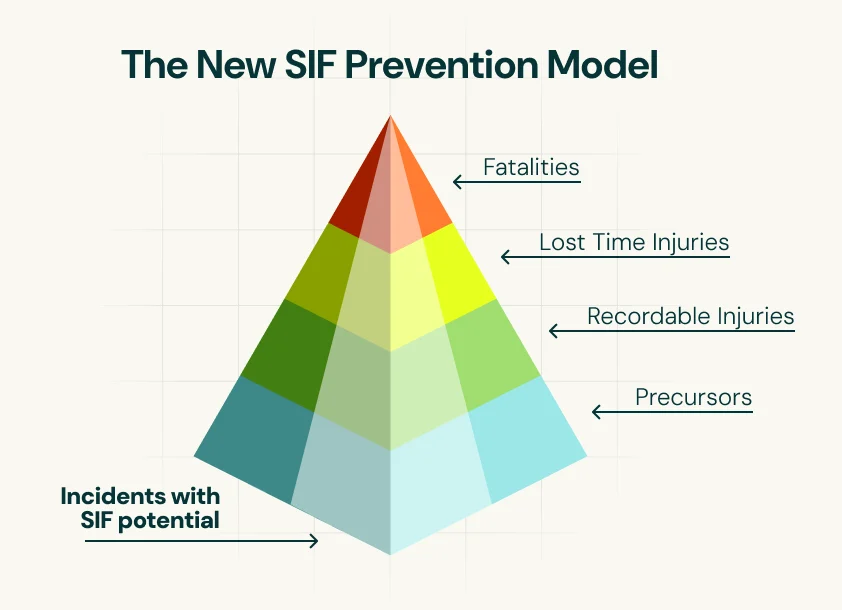
SIF prevention also looks at potential SIFs, sometimes called pSIFs. A potential SIF is an event that caused little or no harm but could reasonably have caused a serious injury or death if one or two circumstances had changed. A vehicle narrowly missing a worker deserves attention even when nobody gets hurt.
The National Safety Council’s SIF prevention model encourages organisations to examine these events because they can reveal weak or missing safeguards before someone suffers serious harm.
Why can a low injury rate hide serious risks?
An injury rate and other lagging indicators can tell you what has happened. They cannot, on their own, tell you whether your team has control over the work that could kill or permanently injure someone. Risk can often hide behind a positive-looking dashboard.
Imagine two reports from the same site. One records a minor cut. The other records a suspended load that passed close to a worker but caused no injury. An incident count captures both. A SIF review asks a further question: What could realistically have happened, and what stopped it?
That distinction matters when leaders set priorities. If you focus only on reducing the number of reported incidents, you may miss the exposures with the most severe possible outcomes.
Research discussed by Krause Bell Group found that the conditions preceding serious injuries and fatalities can differ from those preceding less severe injuries.
You should still prevent minor injuries. You should also give high-consequence risks the attention they deserve.
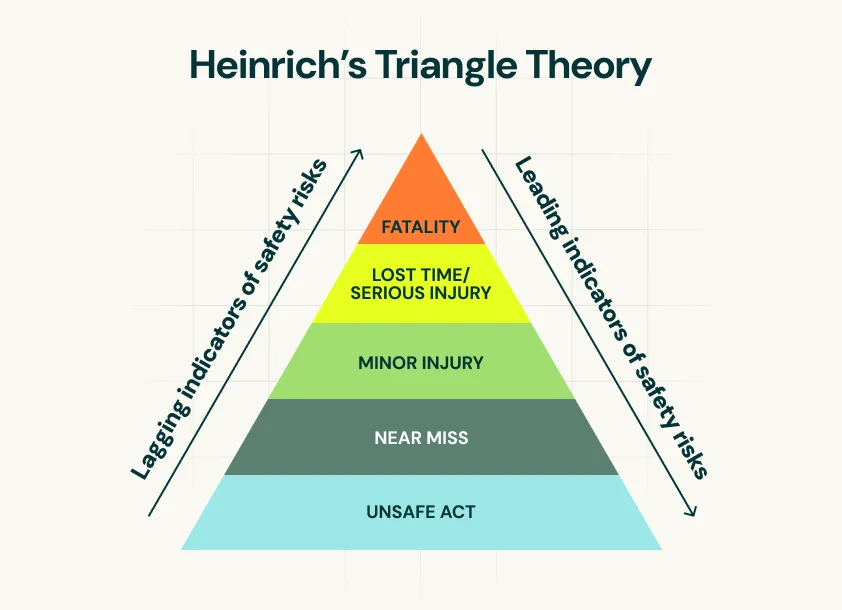
What does Heinrich’s Triangle tell us?
Heinrich’s Triangle introduced the idea that minor incidents, serious injuries, and fatalities have a relationship. It helped make incident prevention a central part of safety management.
In the original conception of the triangle (1931), Herbert William Heinrich theorised that for every major injury or fatality there were:
- 29 minor injuries
- 300 non-injury accidents
Over the years the theory has been developed and the triangle amended (such as by Frank E. Bird in 1966) to show the relationship between accident severity and accident frequency. Bird also claimed that most accidents could be prevented through human intervention.
Relating Heinrichs Triangle to SIFs
More recently, there has been criticism levied at Heinrichs triangle. Its focus on the reduction of minor, common hazards could lead to more serious, less likely risks going unnoticed.
As noted by the Campell Institute, “not all non-injury incidents are equal in terms of their potential for resulting in SIF”. Incidents with the potential to become serious injuries and fatalities are fundamentally different in terms of root causes and context and as such, require a different perspective on the traditional triangle model.
Another criticism of the Heinrich Triangle is its focus on the actions of the victim of the incident. This can lead to systemic safety issues being ignored while exonerating the employer of any responsibility.
Rather than focus solely on the worker, the Campbell Institutes report recommends designing work processes in a way that mitigates human error and makes safety dependent on the organisations safety management system.
What can Safety Differently add?
Safety Differently encourages leaders to understand how people complete work in real conditions. Organisations need to understand the difference between ‘work as imagined vs. work as done’. Plans and procedures matter, but teams also face changing equipment, competing demands, and unexpected problems.
Ask workers where a task becomes difficult, which safeguards they rely on, and what helps them keep work safe when conditions change. Their answers can reveal risks that a report or dashboard misses. Then give them the time, authority, and support to act on what they find.
Which workplace activities have SIF potential?
The answer depends on your operations. Start with work that involves a credible path to life-changing harm, such as falls from height, moving vehicles, hazardous energy, lifting operations, confined spaces, dangerous substances, or high-risk maintenance.
Then look more closely. A task name alone will not tell you whether people face a serious risk today. Ask:
- What could release energy, move unexpectedly, fall, ignite, or expose someone to a harmful substance?
- Who could enter the danger area, including contractors and nearby workers?
- What would happen if a key safeguard failed?
- Does the task change across shifts, sites, weather conditions, or equipment types?
- Have workers reported a near miss, workaround, or concern?
Review routine work as well as unusual jobs. Familiarity can make a hazardous task feel ordinary, while a change in staffing, equipment, or timing can alter the risk quickly.
Calculate your safety ROI and build a business case your board can’t ignore
Get the ROI of safety software in minutes with our free safety ROI calculator.
How do you build a SIF prevention strategy?
A useful strategy connects the risks you identify to clear decisions, strong controls, and regular checks. Start with one high-risk activity, learn what works, and apply that learning across similar work.
1.
Agree on what counts as SIF potential
Give teams a shared way to assess potential outcomes. Define the serious injuries you include, explain how to judge a credible worst-case outcome, and show people when to flag a near miss or low-severity incident for a closer review.
Test the definition with real examples from your sites. If two teams classify the same event differently, discuss why and improve the guidance. Consistency helps leaders spot patterns across the business.
2.
Find where serious harm could happen
Bring together incident reports, near misses, risk assessments, inspection findings, maintenance information, and worker feedback. Look for tasks where people come close to moving equipment, stored energy, a fall, or another high-consequence hazard.
Do not wait for an injury to confirm a risk. Walk through the job with the people who do it. Ask what the task requires on a difficult day, when the plan changes, and where the existing controls need extra effort to work.
3.
Choose controls that address the hazard
For each priority risk, identify the controls that prevent a serious outcome or sharply reduce its likelihood. Where you can, remove the hazard or separate people from it.
The NIOSH hierarchy of controls places elimination, substitution, and engineering controls ahead of administrative controls and personal protective equipment. Training, procedures, permits, and PPE still have a role, but they often depend on people taking the right action every time.
A control also needs a clear owner. Agree who maintains it, who checks it before work starts, and what happens if it fails.
4.
Check controls where work happens
A completed form does not prove that a safeguard works. Ask supervisors and workers to check the controls that matter most at the point of work.
For a lifting operation, that could mean checking the lift plan, equipment, ground conditions, and exclusion area before the load moves. If conditions change, stop, review the risk, and agree on the next safe step.
Record what the checks reveal. Repeated gaps may point to a problem with equipment, job design, scheduling, or the control itself. Fix the reason the gap keeps appearing.
5.
Learn from high-potential events
When an event could have caused serious harm, investigate the conditions that made it possible. Look beyond the last action someone took. Ask how the work developed, which safeguards held, which failed, and what your team needs to change.
Share the learning with other sites that perform similar work. Tell workers what changed because they raised a concern. That follow-through makes it easier for people to speak up next time, and can improve your overall safety culture.
Need buy-in for your EHS software project?
Get 19 essential resources from our toolkit.
What should you measure in a SIF prevention programme?
Track actual serious injuries and fatalities, but do not make them your only measure. These outcomes are too severe to serve as your first signal that a safeguard needs attention.
Choose measures that show whether your team understands and controls its highest risks. Depending on the work, these may include:
| Approach | What it can tell you |
|---|---|
| High-potential events reviewed | Whether teams identify events with serious potential and learn from them |
| Critical control checks completed | Whether people check the safeguards that protect high-risk work |
| Critical control failures found and resolved | Where a safeguard needs repair, redesign, or closer attention |
| Corrective actions completed and checked | Whether a change solved the problem it aimed to address |
| Worker concerns about high-risk work | Where plans and real working conditions may differ |
Read these measures together. A rise in high-potential reports, for example, may mean workers feel more confident speaking up. Check the quality of the reports, the risks they reveal, and the actions that follow before you draw a conclusion.
Give leaders a short set of questions alongside the numbers: Which serious risks did we find this month? Which controls failed? What changed? How do we know the change works?
How do you make SIF prevention work across teams and sites?
Set a common standard for what teams report and how they assess SIF potential. Then leave room for each site to describe its own hazards and working conditions.
A logistics warehouse, manufacturing facility, construction project, and chemical plant will not face the same exposures.
Give people clear roles. Senior leaders set priorities and provide resources. Safety teams help define the method and review patterns. Operational leaders make time for checks and resolve problems. Workers and contractors explain how the task works in practice and raise concerns when conditions change.
Review the strategy at a steady pace. Bring high-potential events, control checks, overdue actions, and worker feedback into the same conversation. If one site finds a weakness that others may share, act across the business.
You do not need a serious incident to begin. Choose one high-risk activity, check its safeguards with the people doing the work, and make one meaningful improvement.
Start with the risk that matters most
You can’t prevent what you can’t see. When you look closely at high-risk work, listen to the people who do it, and check the safeguards they depend on; you give your team a stronger chance to act before someone gets hurt.
EHS management software can help effectively manage safety across your organistion, reducing the opportunities for SIFs to occur.
- Improved hazard recognition: Intuitive mobile EHS solution simplifies how workers identify hazards and perform proactive safety.
- Increase safety awareness: Training and learning software helps companies and frontline workers prevent serious injuries through targeted, on-demand training.
- Clear communication and planning: Permit-to-Work software enhances communication among teams during high-risk activities, ensuring cohesive and clear coordination.
- Increased visibility of high-severity scenarios: Hazard assessment and risk management software takes a risk-based approach to proactively pinpoint high-severity scenarios.
- Rapid emergency response: Emergency and crisis management software lets you respond quickly during major crisis events with real-time coordination and ensure swift action and mitigation.
Ready to begin your EHS management software journey? See what you can expect with our quick video below:
EHS software your workers will WANT to use 👇
Get a demo of our EHS software today 👇
Frequently asked questions
SIF means serious injury and fatality. The term describes workplace outcomes that cause death or life-changing harm. Safety teams also use it when they assess whether an event had the potential to cause one of those outcomes. Agree on a written definition so everyone reviews events against the same standard.
A potential SIF is an event that caused no injury or a less severe injury but could reasonably have caused a serious injury or death. For example, a vehicle that narrowly misses a pedestrian may reveal a serious gap in how your site separates people and vehicles. Review what made the event possible and which safeguards need attention.
General injury prevention addresses the full range of workplace harm. SIF prevention gives additional focus to exposures that could cause death or permanent injury. The approaches work together: prevent everyday harm, while giving high-consequence risks specific controls, checks, and leadership attention.
No. A low injury rate can show progress, but it cannot confirm that your team controls every high-consequence hazard. Review high-risk tasks, potential SIFs, and the condition of critical controls alongside injury data.
Critical controls are safeguards your team relies on to prevent a serious outcome or reduce its consequences. The exact controls depend on the hazard and task. Identify them during risk assessment, assign responsibility for them, and check that they work when people need them.
Review incidents and near misses where a credible change in circumstances could have led to death or life-changing injury. Include events with no injury when they reveal a high-consequence exposure or a failed safeguard. Use a consistent method, and involve people who understand the work.
Useful leading indicators show whether teams find serious risks, check critical controls, and resolve weaknesses before harm occurs. Examples include the quality of high-potential event reviews, critical control failures, and verified corrective actions. Choose indicators that connect to your actual hazards and prompt a decision.
Technology can help teams report high-potential events, share findings across sites, assign actions, and see where controls need attention. It works best when leaders use that information to make changes in the field and check the results. The goal is clearer decisions and safer work.
EHS management software brings incidents, inspections, risk assessments and chemical data into one platform, so every site follows the same workflows and leaders see a single, comparable view of performance. It standardises the core process while still allowing local configuration for site-specific regulations – closing the gaps where compliance risk usually hides.
Need a little more convincing? Check out our demo video library and ROI calculator. You can also explore our Safety Drift digital hub.
Start with a shared definition of SIF potential and one activity that could cause serious harm. Talk with the people who do the work, identify the controls they rely on, and check those controls where the task happens. Use what you learn to set priorities for the next activity and site